
Florida Hurricane Property Damage Claim: How to Avoid a Denial or Lowball
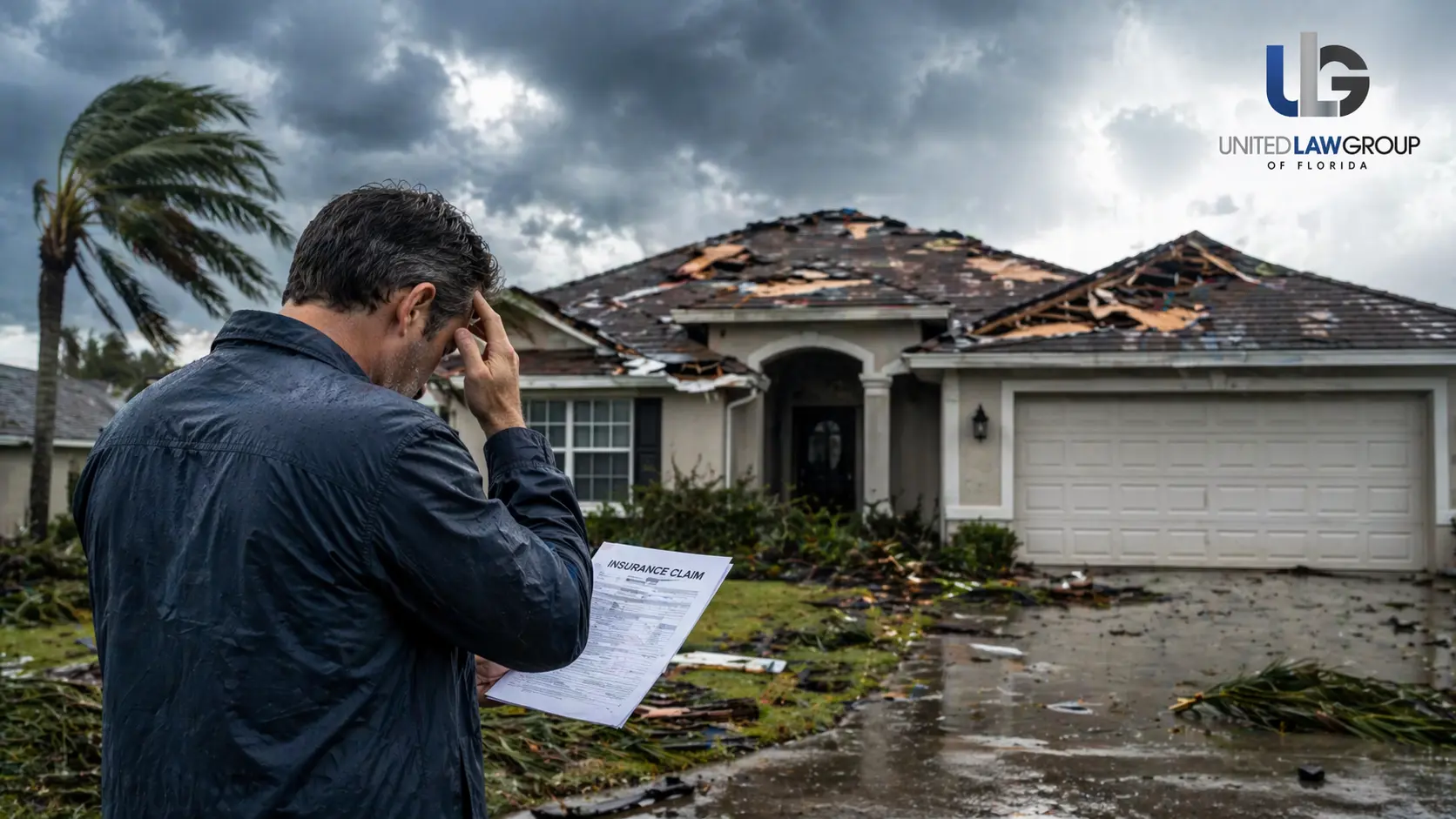
Why Florida Hurricane Property Damage Claims Get Denied or Underpaid
If you own property in Florida, a hurricane claim is not a matter of if but when. What separates a full payout from a denial or a lowball offer is how the claim gets documented, filed, and negotiated. Insurance companies are in the business of collecting premiums and minimizing payouts. They have teams of adjusters, engineers, and lawyers whose job is to find reasons to deny, delay, or devalue your claim.
United Law Group represents Florida property owners after hurricane damage. We handle claims that insurers have denied, underpaid, or dragged out. We also handle first-party claims from the start for owners who want professional representation on a major loss. Free case review at 1-727-351-2806.
The Three Reasons Insurers Deny Florida Hurricane Claims
1. They Blame Everything on Pre-Existing Damage
Florida roofs, windows, and exterior walls age fast in the humidity and salt air. Insurers exploit this by attributing hurricane damage to “wear and tear,” “lack of maintenance,” or pre-existing conditions. They send engineers whose reports read the same on every claim: the damage was not caused by the covered peril.
The rebuttal is documentation. Weather data proving the storm hit your exact location at damaging wind speeds. Pre-loss photos showing the property was intact. Independent engineering reports that counter the insurer’s engineer. Building code experts who can distinguish storm damage from aged wear.
2. They Use the “Wind vs. Flood” Exclusion
Standard Florida homeowners policies cover wind damage. They do not cover flood damage. Flood requires a separate National Flood Insurance Program policy or a private flood policy. After storms, insurers blame flood for what was actually wind-driven rain, wind-blown water intrusion through a compromised roof, or wind-lifted building components that then let water in.
The distinction matters because a policy can pay zero for flood but hundreds of thousands for wind. We dig into the cause-of-loss chain to prove the covered peril was the proximate cause.
3. They Underpay With Lowball Estimates
Even when they accept the claim, insurers routinely estimate repairs below the actual cost to restore the property. They use outdated pricing databases, exclude code-upgrade requirements, skip soft costs like debris removal and engineering, and ignore matching requirements for roofs, windows, and interior finishes.
Florida’s Valued Policy Law, building code upgrade coverage, and matching laws all exist to protect policyholders. Most owners do not know these rights and accept the low estimate. A public adjuster or attorney using the same rules the insurer uses can often double or triple the settlement.
Deadlines That Control Florida Hurricane Claims
Florida’s 2022 and 2023 legislative sessions rewrote the rules for property insurance claims. Current deadlines:
Initial notice of claim: 1 year from the date of loss. This was reduced from 2 years under Senate Bill 2-A in 2022.
Supplemental or reopened claim: 18 months from the date of loss.
Bad faith notice (civil remedy notice): Must be filed and insurer given 60 days to cure before a bad faith suit can proceed. Rules changed under HB 837 in 2023.
Lawsuit deadline: 1 year from the insurer’s final claim decision for most property claims. Shorter than it used to be.
Proof of loss: Most policies require a sworn proof of loss within 60 days of request from the insurer.
Missing any of these deadlines can bar the claim. We track every deadline from day one.
How Florida’s 2022 and 2023 Insurance Reforms Changed Claims
The property insurance market in Florida has been reshaped by multiple legislative sessions. Key changes that affect current claims:
Assignment of benefits reforms. Policyholders can no longer assign benefits to contractors in most circumstances. Contractors must be paid through the policyholder, which changes how repairs get funded during the claim.
Attorney fee changes. The one-way attorney fee statute that let policyholders collect fees from insurers in first-party disputes was largely eliminated. Policyholders now have to negotiate attorney fees into their contingency agreements and settlement structures.
Appraisal and mediation procedures changed. Florida requires specific dispute resolution steps before litigation in many policy types.
Bad faith standards tightened. HB 837 imposed notice and cure periods and tightened the timing of bad faith damages.
These changes make it harder to pursue simple claims without representation. Insurers know policyholders have fewer tools than they used to. Retaining an attorney who knows the current law and has the resources to fund expert work is often the difference between a full recovery and a denied claim.
Common Hurricane Damage Claim Categories
Roof damage. Shingle loss, underlayment exposure, ridge cap displacement, deck damage, and interior water intrusion from roof compromise. Florida building code often requires full roof replacement if 25% or more is damaged.
Windows and sliding doors. Impact damage, frame distortion, seal failure, pressure-damage to glazing.
Exterior walls and cladding. Siding loss, stucco cracking, exterior trim damage, water penetration around openings.
Interior damage. Ceiling collapse from water intrusion, drywall damage, flooring damage, cabinetry damage, personal property loss.
Structural damage. Foundation shifts, wall racking, roof structure damage, garage door collapse.
Code upgrade costs. Florida law and most policies require coverage for costs to rebuild to current code even if the code was not in effect when the property was built.
Additional living expenses. Hotel stays, meals, and other costs while the property is uninhabitable.
Business interruption. For commercial property, lost business income during repairs. Requires careful documentation.
What To Do After a Florida Hurricane
Safety first. Do not enter damaged structures. Watch for downed power lines. Do not drive through standing water.
Document everything. Video walk-through of the entire property. Photos of every damaged area. Save damaged items for the adjuster to inspect.
Protect the property from further damage. Board up broken windows, tarp damaged roofs, remove standing water where safe. Keep all receipts for emergency repairs. These are reimbursable under most policies.
Notify your insurer. Call your insurance company and give initial notice of loss. Get a claim number.
Do not sign anything from contractors or public adjusters without review. Many of these agreements hand over significant rights.
Retain an attorney or public adjuster before the insurer’s appraiser arrives. This is the single most common mistake policyholders make. By the time the insurer’s adjuster writes their estimate and you realize it is too low, the claim has already been shaped in ways that are hard to undo.
How We Handle Florida Hurricane Claims
Documentation. We send our own engineers, contractors, and adjusters to inspect the property. Their reports become the backbone of the claim.
Policy review. We read your full policy. Endorsements, exclusions, and declarations. Many policies contain coverage the insurer “forgets” to mention.
Weather and wind analysis. We obtain NOAA wind speed data, storm tracking records, and post-event wind engineering reports proving the wind speeds and duration at your property location.
Claim negotiation. We prepare a complete demand package with line-item damage documentation, replacement cost estimates including code upgrades, additional living expenses, and any business interruption losses.
Dispute resolution. If the insurer denies or underpays, we move through appraisal, mediation, or litigation as the case requires. We know the current rules under SB 2-A, HB 837, and other recent reforms.
Why Hire United Law Group for Your Florida Hurricane Claim
We represent policyholders, not insurance companies. Every case is handled by a Florida-licensed attorney with property damage claim experience. We know the Florida insurance statutes, the current policy language, and the appraisal and litigation process.
We work on contingency. No fee unless we recover. We advance the cost of engineers, estimators, and expert witnesses. Our fee comes out of the settlement, not out of your pocket upfront.
Call 1-727-351-2806 for a free policy review and claim evaluation. We will tell you honestly whether we think we can help and what your claim is likely worth.
Frequently Asked Questions
Q: How long do I have to file a Florida hurricane damage claim?
A: Under Senate Bill 2-A (2022), Florida property owners have 1 year from the date of loss to file initial notice of a claim and 18 months to file a supplemental or reopened claim. This was reduced from 2 years under prior law. Lawsuit deadlines are typically 1 year from the insurer’s final claim decision. These deadlines have been tightened significantly in recent years. Missing any deadline can bar the claim.
Q: Does Florida homeowners insurance cover hurricane damage?
A: Standard Florida homeowners insurance covers wind damage from hurricanes. It does not cover flood damage, which requires a separate National Flood Insurance Program policy or private flood policy. Most hurricane damage disputes come down to wind versus flood causation. Wind-driven rain through a wind-damaged roof or window is typically covered. Pure flood (storm surge, rising water) is not covered under standard policies.
Q: What is the hurricane deductible on a Florida homeowners policy?
A: Florida homeowners policies carry special hurricane deductibles that are typically 2%, 5%, or 10% of the dwelling coverage amount. On a $400,000 dwelling policy, a 5% deductible is $20,000. Hurricane deductibles are usually higher than standard deductibles. They apply only when a named hurricane triggers the policy’s hurricane deductible clause. Understanding which deductible applies affects the settlement calculation.
Q: Why did the insurance company deny my hurricane claim?
A: Florida insurers commonly deny or underpay hurricane claims by blaming pre-existing damage, citing flood exclusions for wind-driven water, arguing the damage was gradual rather than storm-caused, or claiming maintenance failures caused the loss. Denials often rely on engineer reports that favor the insurer. Proper weather data, independent engineering, and Florida building code analysis can overcome most denials.
Q: Can I still file a claim if the insurance adjuster already came?
A: Yes. An adjuster’s initial visit does not close the claim. You can dispute the adjuster’s findings, request a re-inspection, invoke appraisal, or file suit. Many policyholders accept a lowball initial estimate without realizing they have ongoing rights. Hiring an attorney or public adjuster after the initial visit is common and often necessary to get a fair settlement.
Q: What is the Valued Policy Law in Florida?
A: Florida’s Valued Policy Law (FS 627.702) requires insurers to pay the full policy limits when a covered peril causes a total loss. The insurer cannot pay less than the face value of the policy even if actual repair costs are lower. This law protects policyholders from undervalued settlements on total-loss claims. It applies to covered perils including hurricane wind damage that totals a structure.
Q: Do I need a lawyer for my Florida hurricane claim?
A: You do not need a lawyer for small, straightforward claims with cooperative insurers. You should strongly consider one for any claim over $25,000, any denial, any significant underpayment, or any case involving wind-versus-flood causation. Florida’s 2022 and 2023 insurance reforms eliminated many policyholder-friendly rules including one-way attorney fees. Representation is more important than ever because the tools available to policyholders are fewer than they used to be.