
How Florida Law Protects Homeowners After Storm Damage (2025 Homeowners’ Rights Update)
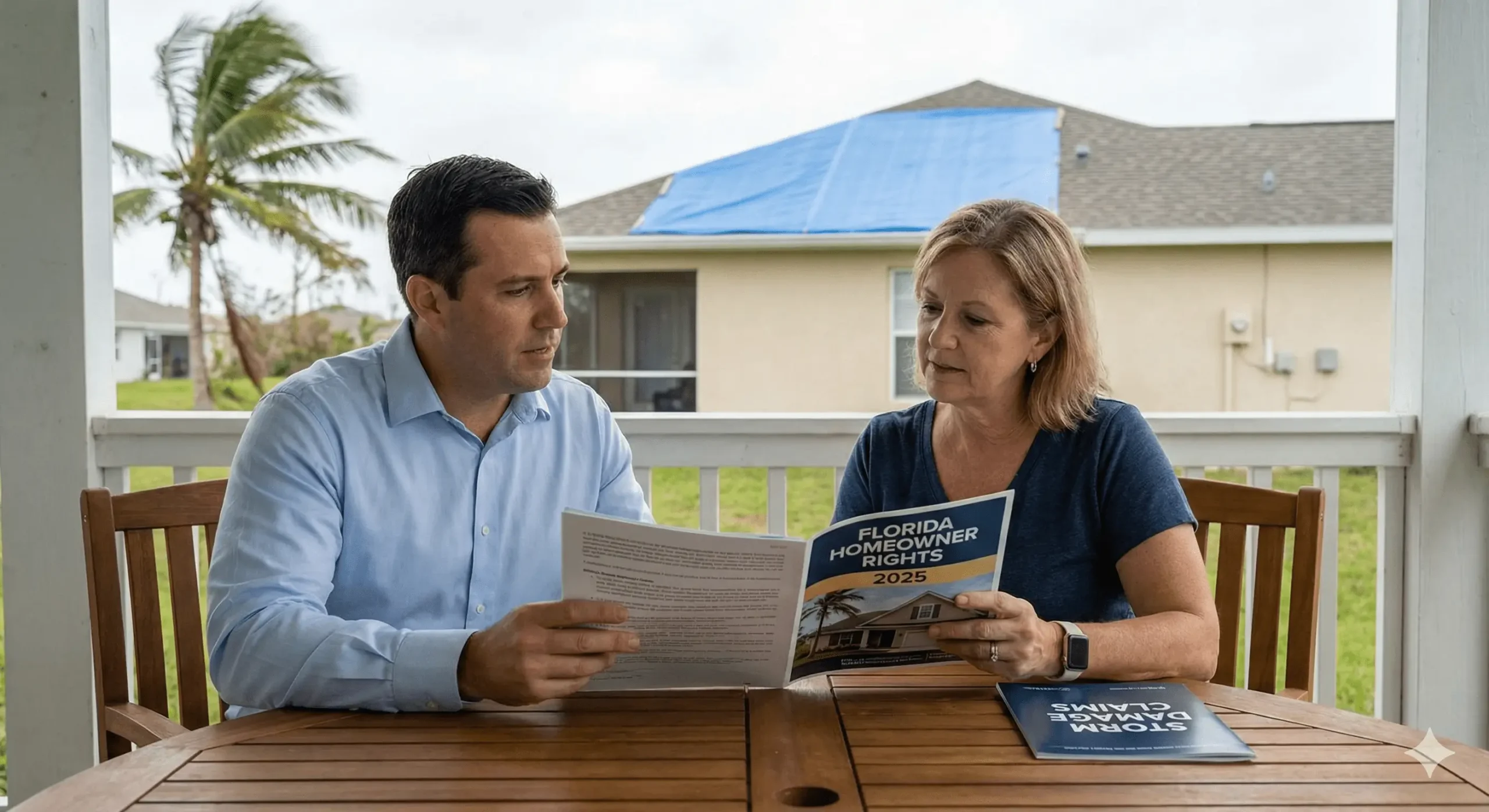
Florida homeowners now face strict reporting deadlines and accelerated insurance timelines after hurricanes and severe storms. Missing a single statutory requirement can permanently bar recovery, even when damage is extensive.
This 2025 update explains the Florida laws that govern storm damage claims, including insurer obligations, filing deadlines, total-loss protections, and the legal consequences of delayed or underpaid payments.
The Homeowner Claims Bill of Rights: The Legal Framework Governing Storm Claims
Florida Statute §626.9641 governs how insurers must acknowledge, inspect, estimate, and pay storm-related property damage claims involving wind, roof, and water intrusion. Violations often arise in Florida property damage claims when insurers delay inspections, fail to issue estimates, or withhold payment.
Mandatory Insurance Timelines Under Florida’s Prompt Pay Laws
After a Notice of Loss is submitted, insurers must acknowledge the claim within 7 days, begin inspection within 7 days when required, deliver written estimates within 7 days of preparation, and pay or deny the claim within 60 days. Missed deadlines may trigger statutory interest and support claims of improper handling.
Undisputed Payments Cannot Be Withheld
Florida law requires insurers to release payment for undisputed portions of a storm damage claim even when other components remain contested.
This obligation commonly applies when roof damage is approved but interior water damage or structural repairs are disputed.
The 1-Year Rule: Florida’s Non-Negotiable Storm Damage Deadline
Florida Statute §627.70132 limits how long homeowners have to report storm damage after hurricanes and named storms, and this deadline controls whether insurers must consider coverage. Claims reported after the deadline may be denied regardless of severity.
Initial Storm Damage Claims Must Be Reported Within One Year
Homeowners must submit a Notice of Loss within one year of the storm’s landfall, not when damage becomes visible or worsens. Claims filed after this deadline are barred even if later inspections confirm storm-related roof or water damage.
Supplemental Claims Are Limited to 18 Months
Additional damage discovered during repairs must be reported within 18 months of the storm date, even if the original claim was timely and partially paid. Contractor delays and material shortages do not extend this statutory limit.
Florida’s Valued Policy Law: Mandatory Payment for Total Losses
Florida Statute §627.702 requires insurers to pay the full policy limit when a covered peril causes a total or constructive total loss, prohibiting reductions based on depreciation or property age. This statute is most often invoked after hurricanes that render homes structurally unsafe or legally unrepairable.
When the Valued Policy Law Applies
If hurricane wind alone would have rendered the home a total loss, insurers must pay the full face value of the policy, including situations where local building codes require demolition. The analysis focuses on repair feasibility rather than cosmetic damage.
Wind vs. Flood Causation Disputes
When insurers attribute destruction to excluded flood damage, homeowners must establish that wind damage alone would have caused a total loss under Florida law. Structural failure, roof uplift, and breach of the building envelope are central to this determination.
How Recent Florida Laws Changed Insurance Lawsuits
House Bill 837 restructured property insurance litigation by eliminating automatic fee-shifting and increasing the financial risk of pursuing lawsuits over underpaid storm claims. Homeowners must now evaluate disputes based on potential recovery versus litigation cost exposure.
Elimination of One-Way Attorney Fees
Florida homeowners are no longer entitled to automatic attorney fee recovery when insurers underpay claims, even when disputes resolve in the homeowner’s favor. Each party generally bears its own legal costs, requiring early assessment of claim value and evidentiary strength.
Bad Faith Claims Now Require a Cure Period
Before pursuing bad-faith damages, homeowners must file a Civil Remedy Notice and allow insurers 60 days to cure violations by issuing payment or correcting claim handling. A timely cure limits recovery to the underlying claim amount.
State-Supported Alternatives to Litigation
Florida law permits homeowners to challenge underpaid storm damage claims without immediately filing suit while still compelling insurer participation. These mechanisms are commonly used when coverage is acknowledged but valuation or repair scope remains disputed.
Florida DFS Mediation for Property Insurance Claims
DFS mediation requires insurers to attend with settlement authority at no cost to homeowners and negotiate disputed storm damage claims. It is most effective when coverage is accepted but pricing, scope, or valuation remains contested after a hurricane.
How United Law Group Helps Florida Homeowners After Storm Damage
United Law Group represents homeowners facing delayed payments, underpaid repairs, and denied coverage after hurricanes and severe storms across Florida. Our attorneys handle storm damage, roof damage, and insurance dispute matters statewide.
If your insurer is delaying or minimizing payment after storm damage, United Law Group can evaluate your claim and pursue the compensation Florida law allows with no fees unless we win.
Get your free case evaluation today.
FAQS
How long do homeowners have to report storm damage in Florida?
Florida law requires initial storm damage claims to be reported within one year of the storm’s landfall date, not the date damage is discovered.
What happens if storm damage is discovered during repairs?
Additional damage must be reported as a supplemental claim within 18 months of the storm date, even if the original claim was timely and partially paid.
Can insurers delay payment if part of the claim is disputed?
Florida law requires insurers to release payment for undisputed portions of a claim even when other damages remain contested.
When does Florida’s Valued Policy Law require full policy payment?
The law applies when hurricane wind causes a total or constructive total loss, requiring insurers to pay the full face value of the policy.
What options exist if an insurer underpays a storm damage claim?
Homeowners may pursue DFS mediation, file a Civil Remedy Notice, or evaluate litigation depending on claim value and dispute scope