
Florida Catastrophic Injury Compensation: The 2026 Guide
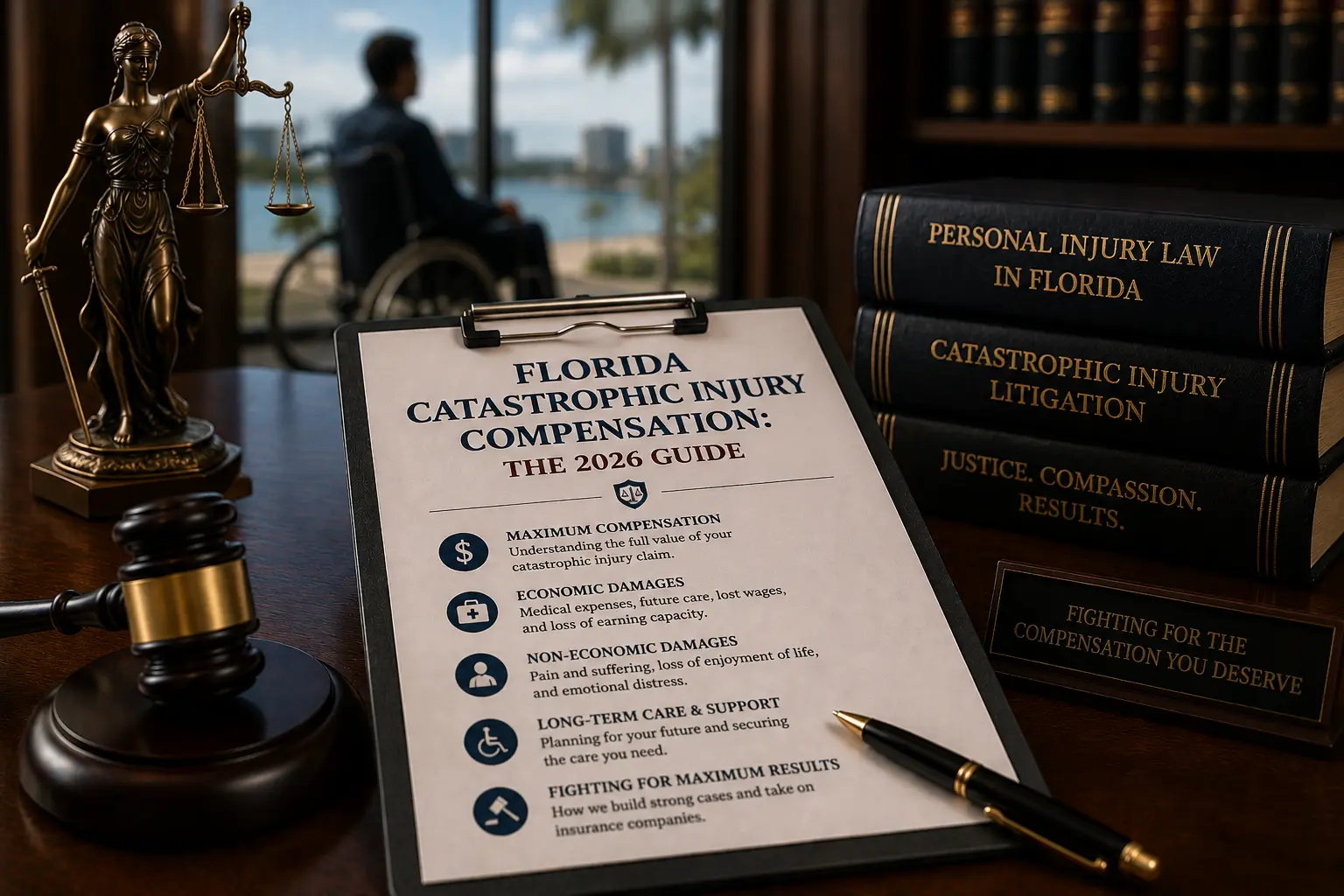
Florida catastrophic injury settlements typically range from $500,000 to $5 million or more, with the highest cases (paralysis, severe TBI, multiple amputations) reaching $10 million or more depending on policy limits. Compensation includes economic damages (past and future medical, lost earnings, lost earning capacity, life-care plan costs) and non-economic damages (pain and suffering, loss of enjoyment of life, mental anguish), calculated using the multiplier method in most cases. The multiplier for catastrophic injuries usually runs 4 to 5 times the economic damages, sometimes higher. Florida HB 837 (2023) and the modified 51% comparative negligence rule shape every catastrophic case.
Free case review. We tell you what your catastrophic case is worth based on your facts. Florida statewide.
Tell us the injury and how it happened. We will give you a real range based on Florida case data.
What Counts as a Catastrophic Injury Under Florida Law?
Florida law defines a catastrophic injury as a severe injury that results in permanent impairment to physical or mental abilities, loss of a bodily function, or significant disfigurement or scarring. The term is used in Florida workers’ compensation law (Fla. Stat. 440.02), but in personal injury cases the practical definition focuses on severity, permanence, and impact on the person’s ability to work, live independently, and enjoy life.
Specific Injuries Florida Courts Treat as Catastrophic
- Traumatic brain injury (TBI) with cognitive or behavioral changes
- Spinal cord injury with paralysis (paraplegia, quadriplegia)
- Amputation (single or multiple limbs)
- Severe burns over significant body surface area
- Loss of vision in one or both eyes
- Loss of hearing
- Multiple fractures requiring hardware and ongoing care
- Internal organ damage requiring transplant or permanent dysfunction
- Severe scarring or disfigurement, particularly visible facial scarring
- Permanent loss of reproductive function
How Florida Calculates Catastrophic Injury Compensation
Florida personal injury damages divide into two buckets: economic damages (medical bills, lost wages, lost earning capacity, life-care plan) and non-economic damages (pain and suffering, loss of enjoyment, mental anguish). Economic damages are calculated by adding documented and projected costs. Non-economic damages are calculated using the multiplier method or the per diem method, with the multiplier method dominating in catastrophic cases.
The Multiplier Method Explained
The multiplier method takes total economic damages and multiplies by a factor between 1.5 and 5 (sometimes higher) to estimate non-economic damages. The multiplier scales with severity, permanence, and life impact. Soft-tissue injuries with full recovery use 1.5x to 2x. Moderate injuries with surgery and ongoing PT use 2.5x to 3.5x. Catastrophic injuries with permanent impairment use 4x to 5x. Cases with extreme suffering, public visibility, or particularly egregious defendant conduct can support multipliers above 5x.
Worked Example: TBI Case
32-year-old client suffered a traumatic brain injury in a Florida trucking accident. Past medical: $385,000. Future medical projection (life-care plan): $2.4 million over remaining life expectancy. Past lost wages: $48,000. Lost earning capacity: $1.6 million (career ended at age 32, projected through age 65 with vocational economist). Total economic damages: $4.43 million. Catastrophic multiplier: 4.5x. Non-economic damages: $19.9 million. Total demand: $24.3 million. Settlement reached: $5.2 million (capped by available policy and excess coverage).
Worked Example: Spinal Cord Injury Case
47-year-old paraplegic from a Florida motorcycle accident. Past medical: $620,000. Future medical projection: $4.8 million (life-care plan including home modifications, equipment replacement cycles, attendant care). Past lost wages: $95,000. Lost earning capacity: $1.9 million. Total economic damages: $7.4 million. Catastrophic multiplier: 5x. Non-economic damages: $37 million. Total demand: $44.4 million. Settlement reached: $6.8 million plus a $750,000 supplemental settlement from a secondary defendant.
Free Catastrophic Injury Case Review
Tell us the injury, how it happened, and what your medical situation looks like. We will give you a real range.
Call (727) 306-3324 for a free case review.
What Drives Catastrophic Injury Settlement Value
1. Future Medical Care Projection (Life-Care Plan)
Most plaintiff lawyers settle catastrophic cases on past medical bills plus a guess at future care. We do not. Every catastrophic case gets a certified life-care planner who builds a year-by-year projection of medical, attendant care, equipment, home modification, and therapy costs through the client’s remaining life expectancy. The life-care plan is then reduced to present value by an economist. The number we present in mediation is rigorous and verifiable.
Life-care plans for catastrophic cases routinely run $1 million to $10 million in projected future medical alone. That number drives the entire damages model. Insurers do not pay full multipliers without a credible life-care plan in hand.
2. Lost Earning Capacity (Vocational Economist)
Lost earning capacity is the difference between what the client could have earned without the injury and what they can earn now. We retain a vocational economist to assess pre-injury earning trajectory, post-injury work limitations, and present-value reduction. For a 32-year-old who can no longer work, lost earning capacity often runs $1.5 million to $3 million depending on industry and credentials.
3. Pain and Suffering Multiplier (Severity-Based)
The multiplier itself is negotiated based on severity. A multiplier of 5x on a $4 million economic-damages base is $20 million. A multiplier of 4x on the same base is $16 million. The $4 million swing is often where mediation lands. We document daily impact, treatment burden, and prognosis to support the higher multiplier.
4. Defendant Conduct (Punitive Multiplier)
Punitive damages under Fla. Stat. 768.73 apply when the defendant acted with gross negligence or intentional misconduct. Punitives are capped at the greater of three times compensatory damages or $500,000 in most cases, with higher caps for specific bad acts. Drunk driving, racing, and willful safety violations support punitive multipliers in catastrophic cases.
5. Available Insurance Coverage
The biggest practical limit on catastrophic injury recovery is policy limits. A $5 million case against a defendant with a $250,000 policy is still a $250,000 case unless we find additional defendants or coverage layers. We map every available policy: defendant’s primary, defendant’s excess, employer’s vicarious coverage, vehicle owner’s coverage, your own UM/UIM (stacked when applicable), and any umbrella policy. Catastrophic cases require this coverage map on day one.
How Florida HB 837 Changed Catastrophic Cases
Florida HB 837, signed March 24, 2023, made three changes that affect every catastrophic injury case.
Modified 51% Comparative Negligence
Florida moved from pure comparative negligence to a modified 51% bar. If a jury finds you more than 50% at fault, you recover zero. In catastrophic cases, defense lawyers push hard to get the jury to assign 51% to the plaintiff, which would zero out a multi-million dollar case. We document every defendant contribution to the wreck or incident and structure liability discovery to keep the comparative needle on the right side.
Two-Year Statute of Limitations
HB 837 reduced the negligence statute of limitations from four years to two years for incidents on or after March 24, 2023. Catastrophic cases require time to build (life-care planning, vocational assessment, medical maximum improvement), but the two-year clock now runs faster. We start case workup in the first 30 days to preserve evidence and meet the deadline with margin.
Medical Damages Cap on Future Bills
HB 837 also limits how plaintiffs can prove medical damages. Specifically, plaintiffs can no longer use the full “billed amount” for past medical care if insurance paid a lower negotiated rate. The new rules require plaintiffs to prove the actual amount paid, not the gross billed charge. This change reduces past medical damages on most cases, which in turn reduces the multiplier base. We adjust our demand strategy by leaning harder on future medical projections (which are not affected by the new rule) and on lost earning capacity.
Common Florida Catastrophic Injury Case Types
- Trucking and 18-wheeler crashes (highest case values, $1M+ commercial policies)
- Motorcycle vs. passenger vehicle crashes (severe injuries common)
- Uber and Lyft crashes (rideshare $1M policy when on a fare)
- Pedestrian and cyclist hit by vehicle (often catastrophic outcomes)
- Workplace falls and equipment failures (often involves third-party claims)
- Defective product injuries (medical devices, vehicles, industrial equipment)
- Severe burn injuries (electrical, chemical, fire)
- Drowning and near-drowning (pool, boating)
- Medical malpractice (surgical errors, anesthesia errors, birth injuries)
- Construction site accidents (third-party claims outside workers’ comp)
How Florida PIP Affects Catastrophic Cases
Florida is a no-fault state. Every Florida auto policy must include $10,000 in Personal Injury Protection (PIP) coverage under Fla. Stat. 627.736. PIP pays 80% of medical bills and 60% of lost wages, up to the $10,000 cap, regardless of fault. PIP exhausts fast in catastrophic cases. A single ER visit and surgery can blow through $10,000 inside 48 hours.
Once PIP is exhausted, you fall back on health insurance, MedPay add-ons, and ultimately the at-fault driver’s bodily injury liability coverage. To step outside no-fault and recover full pain and suffering damages from the at-fault driver, your injury must cross the significant injury threshold under Fla. Stat. 627.737. Catastrophic injuries always cross the threshold by definition: permanent injury, significant disfigurement, or significant loss of bodily function all qualify.
Keep careful track of PIP exhaustion. Hospitals and providers will sometimes bill PIP and stop, even when there is more medical care needed. We coordinate with treating providers to ensure billing flows correctly through PIP, then health insurance, then MedPay, then the liability case at the end.
MedPay add-ons typically range from $1,000 to $25,000 in Florida and are optional. If you carry MedPay, it stacks on top of PIP and pays the 20% PIP co-share. In catastrophic cases, that extra cushion buys you time to get treated without out-of-pocket bleeding while we build the underlying liability case.
Insurance Stacking: The Catastrophic Recovery Multiplier
Catastrophic cases live or die by the available insurance. The single biggest mistake unrepresented victims make is settling with the at-fault driver’s primary policy and never pursuing other coverage layers. We map every layer on day one.
Layer 1: At-Fault Driver’s Primary Liability
Florida minimum bodily injury liability is $10,000 per person, $20,000 per accident under Fla. Stat. 324.022, but that requirement applies only to financial responsibility. Most drivers carry $25,000 to $100,000 in primary liability. Catastrophic cases blow through these limits in hours.
Layer 2: At-Fault Driver’s Excess or Umbrella
Higher-income defendants often carry umbrella policies of $1 million or more on top of their primary auto policy. We always demand a complete coverage disclosure under Fla. Stat. 627.4137, which requires insurers to disclose all coverage available within 30 days of a written request.
Layer 3: Vehicle Owner’s Policy (Vicarious Liability)
If the at-fault driver was operating a vehicle owned by someone else, Florida’s dangerous instrumentality doctrine makes the owner vicariously liable for the driver’s negligence. The owner’s policy stacks on top of the driver’s policy.
Layer 4: Employer Coverage (Course and Scope)
If the at-fault driver was on the job at the time of the wreck, the employer’s commercial auto and general liability policies are in play. Commercial policies often run $1 million per occurrence with stacked excess.
Layer 5: Your Own UM/UIM Coverage
Florida UM/UIM coverage pays you when the at-fault driver is uninsured or underinsured. If you carry stacking-eligible UM coverage, the limits multiply by the number of vehicles on your policy. Three vehicles with $100,000 stacking-eligible UM equals $300,000 in available coverage. We always check UM stacking on every catastrophic case.
What to Do in the First 30 Days After a Catastrophic Injury
- Focus on medical treatment. Catastrophic cases are won by aggressive medical care, full documentation, and reaching maximum medical improvement before settlement.
- Hire a catastrophic injury attorney within the first week. Evidence preservation, coverage mapping, and life-care planning need to start fast.
- Do not give recorded statements to any insurance company, including your own. Adjusters use casual statements as inconsistencies later.
- Document everything. Photographs of injuries, medical records, treatment timelines, and changes to daily life. Catastrophic damages live in details.
- Identify all available insurance layers immediately. Ask for written coverage disclosures from every potential defendant under Fla. Stat. 627.4137.
- Stay off social media. Defense lawyers screenshot every post in catastrophic cases. A photo of you smiling at a family event becomes evidence in court that you were not really hurt.
- Keep a daily journal of pain, treatment, missed activities, and emotional impact. Pain and suffering multipliers are supported by these contemporaneous records.
Frequently Asked Questions
How much can you get for a catastrophic injury in Florida?
Florida catastrophic injury settlements typically range from $500,000 to $5 million or more, with the highest cases (severe TBI, paralysis, multiple amputations) reaching $10 million+ depending on policy limits and defendant conduct. Median for spinal cord and severe TBI cases falls in the $1.5 million to $4 million range.
What counts as catastrophic injury in Florida?
Florida law defines catastrophic injury as severe injury resulting in permanent impairment to physical or mental abilities, loss of a bodily function, or significant disfigurement or scarring. Common examples include TBI with cognitive changes, spinal cord injury with paralysis, amputation, severe burns, vision or hearing loss, and permanent organ damage.
How does future medical care affect my settlement?
Future medical care is often the biggest single component of a catastrophic damages model. A certified life-care planner projects medical, attendant care, equipment, home modification, and therapy costs through your remaining life expectancy. Life-care plans for catastrophic cases routinely run $1 million to $10 million in projected future medical alone.
What is the multiplier for catastrophic injury cases in Florida?
Catastrophic injury cases typically use a non-economic damages multiplier of 4x to 5x economic damages. Cases with extreme suffering, public disfigurement, or egregious defendant conduct can support multipliers above 5x. Soft-tissue and moderate injuries use lower multipliers (1.5x to 3.5x).
How long do I have to file a catastrophic injury case in Florida?
Two years from the date of injury under Fla. Stat. 95.11(4)(a) for incidents on or after March 24, 2023. Older incidents have the previous 4-year statute. Government entity claims under Fla. Stat. 768.28 require notice within 3 years (most claims) and have a $200,000 per-person damages cap absent legislative claim.
Can I get punitive damages for a catastrophic injury in Florida?
Yes, when the defendant acted with gross negligence or intentional misconduct under Fla. Stat. 768.73. Punitives are capped at the greater of 3x compensatory damages or $500,000 in most cases. Drunk driving, racing, willful safety violations, and intentional acts support punitive damages.
How long does a catastrophic injury case take?
Most catastrophic cases run 18 to 36 months from sign-up to resolution. The case workup (life-care planning, vocational assessment, reaching maximum medical improvement) takes longer than soft-tissue cases. Settlement is harder to push without complete medical documentation.
How much do catastrophic injury lawyers cost in Florida?
Contingency fee. 33.33% of recovery if settled pre-suit, 40% if a lawsuit is filed. You pay nothing upfront. Costs (life-care planner, vocational economist, accident reconstruction, depositions) come from recovery. Catastrophic cases run $50K-$150K+ in costs because of the expert workup, but those costs come out of settlement.
Compliance & Disclaimer
United Law Group represents clients in Florida and Texas. The information in this article is general and not legal advice. Every case turns on its specific facts. Past results do not guarantee future outcomes. Contacting us does not create an attorney-client relationship; that relationship begins only when a written representation agreement is signed. Florida Bar Rule 4-7.13 requires this disclosure.