
Florida Motorcycle Accident Lawyer: What Riders Need to Know After a Crash
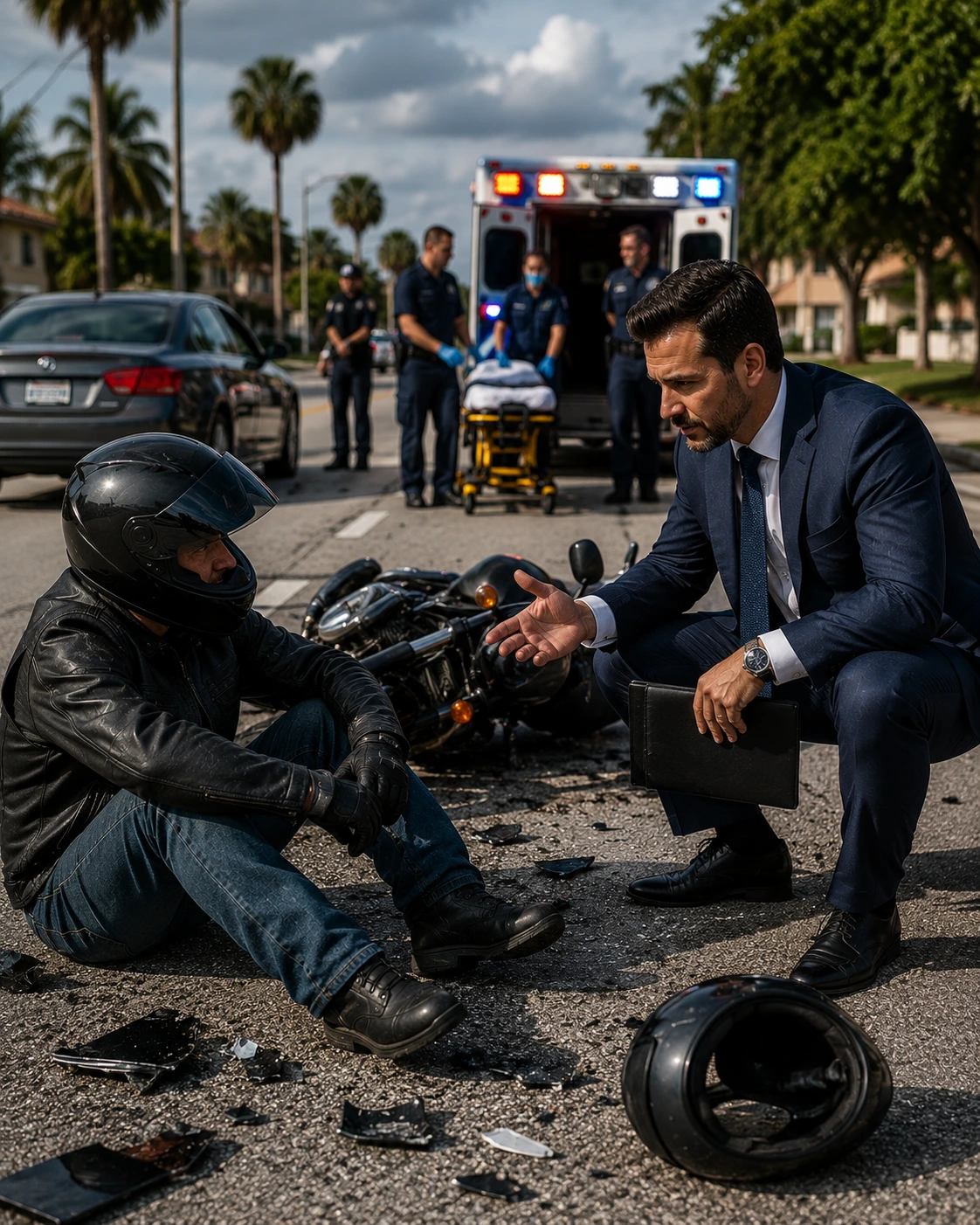
Ask any motorcycle accident lawyer Florida riders actually trust, and you’ll hear the same thing up front: rider cases run on different rules than car crashes, and most of what you’ve heard about Florida injury claims doesn’t apply to you. The no-fault system that controls car wrecks leaves motorcyclists out entirely, and that single fact reshapes everything from who pays your ER bill to what you can sue for.
Quick answer: Florida PIP does not cover motorcyclists. You get no $10,000 no-fault safety net and no 14-day treatment rule, but you also skip the serious injury threshold, meaning you can pursue the at-fault driver for pain and suffering from dollar one. Florida doesn’t require insurance to register a motorcycle, helmets are optional over 21 with $10,000 in medical coverage, and you have two years to file suit.
The no-fault carve-out that changes your whole claim
Section 627.736 builds Florida’s Personal Injury Protection system around ‘motor vehicles,’ and the statutory definition excludes motorcycles. Car occupants tap their own PIP first, 80% of medical bills up to $10,000, no matter who caused the crash. Riders get nothing from that system. Your health insurance, your optional medical payments coverage, or your own pocket covers the first bills.
Now the other edge of the blade, the one insurance adjusters hope you never learn. Car occupants can’t recover pain and suffering unless their injury clears the serious injury threshold in Section 627.737: permanence, significant scarring, or death. That threshold exists only inside the no-fault system. Riders stand outside it. If a driver pulls a left turn across your lane and breaks your wrist, you can pursue the full claim, economic and non-economic damages both, without proving permanence first. In real numbers, a threshold fight that caps a car passenger’s soft-tissue claim simply never happens in your case.
The left-turn crash: where most rider cases start
One crash pattern dominates Florida rider cases: a driver turning left across the rider’s path at an intersection, followed by the words ‘I never saw the motorcycle.’ The physics are brutal because the rider hits the car’s broadside or gets clipped mid-turn with almost no reaction time, and the liability picture is usually clean, because a left-turning driver owes the right of way to oncoming traffic.
Clean doesn’t mean uncontested. Adjusters answer left-turn cases with speed arguments, claiming the rider was going too fast to be seen or avoided. Skid analysis, crush damage measurements, and intersection camera footage beat that argument, which is one more reason scene evidence in week one is worth more than testimony in month ten. The other recurring patterns fill out the docket: drivers changing lanes into riders they never checked for, rear-end hits at lights that launch a rider instead of crumpling a bumper, and doorings in beach-town street parking.
One rule surprises transplants from California: lane splitting is illegal in Florida. Riding between lanes hands the insurer a comparative fault argument on a plate, and under Section 768.81 that percentage comes straight out of your recovery.
Helmets, the law, and the fault argument
Section 316.211 lets riders over 21 go without a helmet if they carry at least $10,000 in medical benefits coverage. Riding helmetless is legal for most Florida adults. That doesn’t stop insurers from weaponizing it. Expect the adjuster to argue your head or neck injury would’ve been milder with a helmet, trying to shave your recovery through comparative fault even though you broke no law.
The counter is medical and mechanical: biomechanics testimony about what a helmet would and wouldn’t have changed, and a clean liability story about the driver who caused the crash in the first place. Juries respond to the difference between a legal choice and a legal violation, and a lawyer who tries these cases knows how to keep that line bright.
The insurance gap nobody warns riders about
Florida doesn’t require any insurance to register a motorcycle. Combine that with roughly one in five Florida drivers carrying no coverage at all, and rider claims hit a wall with ugly regularity: a serious injury, a driver with a $10,000 policy or none, and no PIP behind you.
Uninsured/underinsured motorist coverage is how riders survive that math. UM on your motorcycle policy steps into the at-fault driver’s shoes and pays what they can’t. If you ride in Florida without UM coverage, fixing that costs less than a set of tires and matters more. If your crash already happened, bring every policy in your household to the consultation, because UM sometimes stacks in ways adjusters won’t mention.
Worked example, because the numbers teach faster than the rules: a driver with a $25,000 policy runs a light and puts you down, and your damages reach $200,000. Their carrier tenders the $25,000 and closes its file. With $100,000 in stacked UM across two household policies, another $100,000 becomes available, and your claim recovers $125,000 instead of $25,000. Same crash, same injuries, five times the recovery, decided entirely by a coverage box someone checked years earlier.
Why the deck feels stacked, and how we unstack it
- The bias: ‘I didn’t see him’ gets treated like an excuse instead of a confession. We reframe it, because failing to see a rider in plain view is the negligence, not a defense to it.
- The physics: no steel cage means rider injuries run catastrophic while the driver walks away, and severe injuries mean higher stakes for the insurer, which means harder fights.
- The fault push: Section 768.81 cuts your award by your fault share and zeroes it past 50%, so adjusters work to paint every rider as speeding or lane-splitting.
- The evidence clock: skid marks fade, debris gets swept, and camera footage overwrites in days. Scene work in week one beats reconstruction in month six.
What to do after a Florida motorcycle crash
- Get medical care immediately and follow through. With no PIP deadline forcing you, gaps in treatment become the insurer’s favorite exhibit. Your medical record is the spine of the claim.
- Call 911 and get the crash report. The officer’s diagram and any citation against the driver anchor the fault story, and a report number makes every later insurance conversation shorter and cleaner.
2b. If you’re transported before photos happen, ask a passenger, friend, or even a bystander to shoot the scene. Somebody at every crash has a phone; use theirs.
- Photograph everything: the bike where it landed, the car, the road surface, your gear, your injuries. Gear damage tells impact stories that adjusters can’t argue with.
- Collect witnesses before they scatter. An independent witness outweighs both drivers in a swearing match.
- Say nothing to the driver’s insurer. Decline the recorded statement. Politeness gets converted into fault percentages.
- Preserve the bike. Don’t repair or scrap it until it’s been photographed and, in serious cases, inspected. The bike is evidence.
What a Florida motorcycle settlement looks like
Ranges, with the usual honesty: your medical record and the available coverage set the number, and no average settles anything. That said, rider cases commonly land like this once liability is clear:
- Road rash, sprains, and full-recovery injuries: $15,000 to $75,000
- Fractures and injuries needing hardware or injections: $75,000 to $250,000
- Surgical cases with lasting impairment: $250,000 to $750,000
- Traumatic brain injury, spinal damage, amputation, or death: $750,000 into seven figures, coverage permitting
Because there’s no threshold to clear, pain and suffering is on the table in every one of those tiers, and it often exceeds the medical bills in rider cases. Liens still come out of the recovery, and our guide to medical liens and subrogation covers protecting your net. The two-year filing deadline in Section 95.11 runs from the crash date, and serious cases need most of that time to build properly.
Building the damages side: where rider cases get won or lost
Liability answers who pays. Damages answer how much, and rider cases demand more careful damages work than car crashes because the injuries reach further into a life. A fractured wrist means something different to a mechanic than to an accountant. Road rash that needs grafting carries scarring damages juries take seriously. A rider who loses confidence and sells the bike lost something real, and loss-of-enjoyment damages exist for exactly that.
We build the damages file in layers: every bill and imaging report, treating physician narratives on permanence, a vocational analysis when the injury touches your work, and a day-in-the-life picture of what changed. Run the math on a common case: $85,000 in medical bills, three months off work at $6,000 a month, and a shoulder that will never lift overhead again. The bills and wages total near $103,000, and the non-economic damages on top of that figure typically exceed it. Adjusters open these cases at the bills-only number and hope you never learn the difference.
Passengers and families: claims people don’t know they have
A passenger hurt on the back of a bike holds a claim against whoever caused the crash, and sometimes that includes the rider they were holding onto. Those cases feel awkward inside friendships and marriages, but the claim targets an insurance policy, never a wallet, and skipping it leaves real medical bills unpaid.
When a rider dies, Florida’s wrongful death law lets the spouse, children, or parents recover through a claim the estate brings, and the two-year clock runs from the date of death. These cases carry the highest stakes and the hardest fights, because insurers defend policy-limits exposure with everything they have. Families should talk to counsel before any insurer conversation, not after.
How long a Florida rider case takes
Clear-liability cases with finished treatment settle in 6 to 12 months. Disputed fault, surgical recoveries, and UM claims stretch to 18 months or more, and trial adds its own calendar. The pattern to avoid is the early settle: signing in month three at the insurer’s number, then learning in month seven that the shoulder needs hardware. Releases don’t reopen, so the case timeline has to follow the medical timeline, never the other way around.
Five mistakes that wreck rider claims
- Tough-guy syndrome: skipping the ER, then discovering the herniated disc three weeks later with no record connecting it to the crash.
- Giving the insurer a recorded statement to ‘clear things up.’ It never clears anything up in your favor.
- Fixing or selling the bike before it’s documented.
- Taking the early offer while the shoulder still needs surgery. Signed releases don’t reopen.
- Posting ride videos or gym clips while claiming injury. Defense firms subscribe to your feed the day the claim opens.
A note on bikes and Florida’s Lemon Law
Riders sometimes ask us about defective new bikes, so one clarification: Florida’s Lemon Law excludes motorcycles entirely, a gap we cover in our Florida Lemon Law guide. Warranty and dealer fraud claims can still work; the Lemon Law route just isn’t available for two wheels in Florida.
Cases we take
We take Florida motorcycle cases involving real injuries: fractures, surgeries, head trauma, road rash needing treatment, and every case where a family lost a rider. We take disputed-fault cases, because that’s where lawyers change outcomes most, and we take UM claims against the rider’s own carrier, which fight like any other insurance dispute despite the friendly logo on the policy. A drop-the-bike scrape with no injuries and cosmetic damage doesn’t need a contingency lawyer, and we’ll tell you that in the first five minutes rather than waste your afternoon. Passengers, families, and riders hit as pedestrians all count as rider cases in our book.
How United Law Group handles rider cases
Jack Vasilaros built this firm on treating clients like family, and our Florida personal injury team handles rider cases across the state from our Tampa Bay headquarters. We front the costs, work on contingency, and prepare every case for a jury, because insurers price rider claims off exactly that risk.
Start with a free case evaluation or call 727-306-3324. Bring your policy, the crash report number, and the gear you were wearing.
Frequently Asked Questions
What is the average motorcycle accident settlement in Florida?
No honest average exists, because outcomes range from five figures for full-recovery injuries to seven figures for catastrophic ones. Rider settlements often run higher than car crash settlements at the same medical spend, because pain and suffering is recoverable without clearing the serious injury threshold.
Does Florida require motorcycle insurance?
Not to register the bike. Florida requires no insurance for motorcycle registration, though financial responsibility rules kick in after a crash, and riding helmetless over 21 legally requires $10,000 in medical benefits coverage under Section 316.211. Practically, UM coverage is the policy that saves riders.
Does PIP cover motorcycle riders in Florida?
No. Florida’s PIP statute defines motor vehicles in a way that excludes motorcycles, so riders get no no-fault benefits. The trade-off works in your favor on damages: no serious injury threshold blocks your pain and suffering claim against the at-fault driver.
Can the insurance company use my lack of a helmet against me?
They’ll try, even though helmetless riding is legal over 21 with the required medical coverage. The argument runs through comparative fault, claiming your injuries would’ve been milder. Medical and biomechanical evidence pushes back, and the driver’s negligence remains the core of the case.
How long do I have to file a motorcycle accident claim in Florida?
Two years from the crash under Section 95.11. Evidence timelines run much shorter: camera footage, skid marks, and witness availability degrade within weeks, so the practical deadline for starting is now.
What if the driver who hit me is uninsured?
Your uninsured motorist coverage becomes the case, if you carry it. About one in five Florida drivers has no insurance, and minimum policies cap at amounts a single surgery exceeds. Bring every household policy to the consultation; UM sometimes stacks.
Get a Free Case Review
Bring us the crash report and your policy, and we’ll map every dollar of available coverage in one conversation. No fee unless we win.