
Florida Slip and Fall Settlement Amounts: What Cases Are Worth in 2026
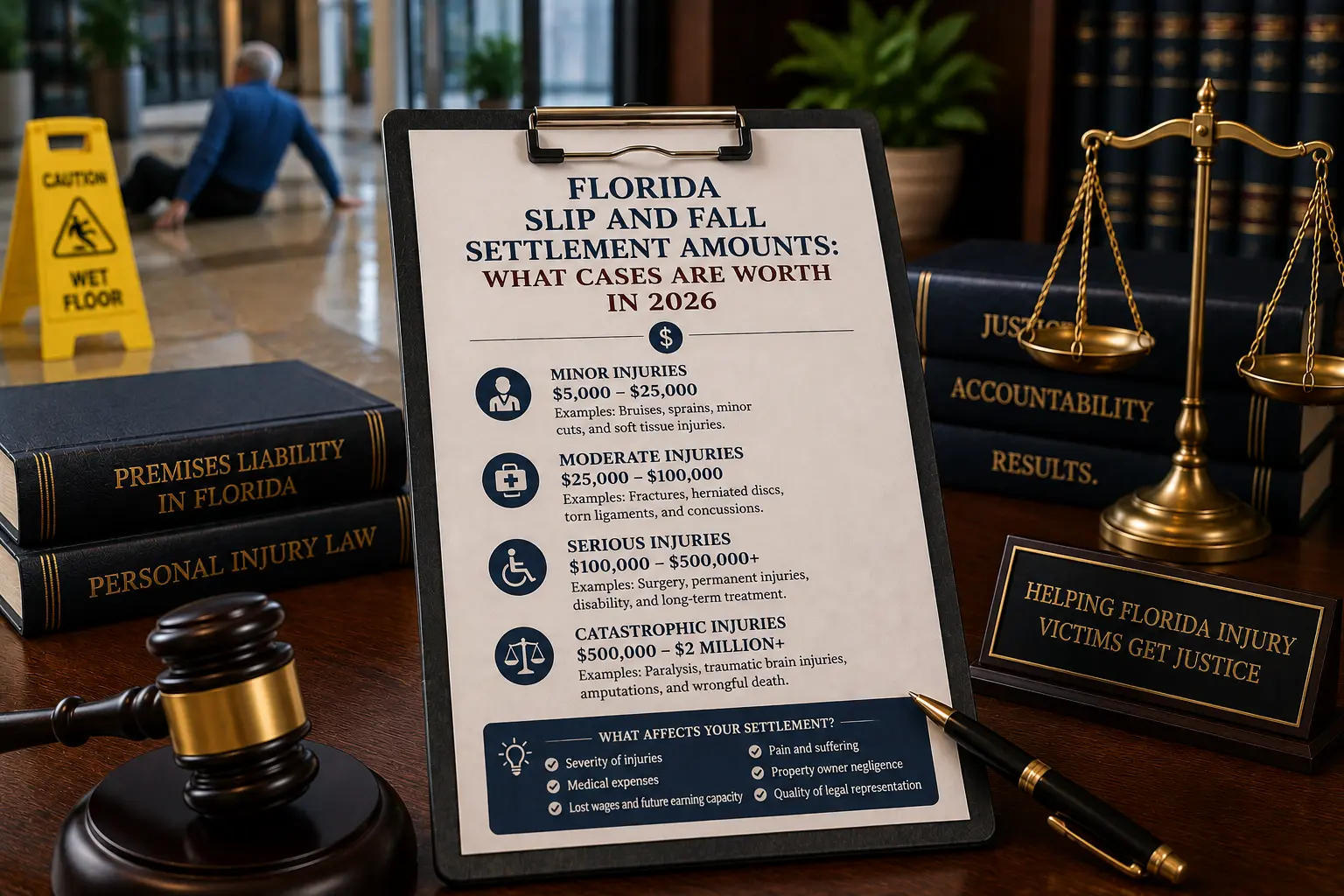
Florida slip and fall settlements typically run from $15,000 for minor cases up to $1.2 million or higher for severe injuries with clear liability. The median for cases involving fractures or surgery falls between $75,000 and $250,000. Settlement value depends on injury severity, the strength of evidence under Fla. Stat. 768.0755 (the transitory foreign substance rule), the property owner’s insurance coverage, and how Florida HB 837’s modified comparative negligence rule applies to your case.
▶ Free case review. We tell you what your slip and fall case is worth in five minutes. Florida statewide.
Tell us where you fell, what you hit, and the injury. We will give you a real settlement range.
How Florida Slip and Fall Law Works (and Why It Decides Your Settlement)
Florida slip and fall cases against businesses run on Fla. Stat. 768.0755, the transitory foreign substance rule. To recover, you have to prove the business had actual or constructive knowledge of the dangerous condition and failed to fix it. This is the highest hurdle in Florida premises liability law, and it is the reason so many slip and fall cases settle low or fail entirely.
Actual Knowledge vs Constructive Knowledge
Actual knowledge is direct evidence the business knew about the spill, leak, or hazard. Examples: a manager saw the spill ten minutes before you fell, an employee created the hazard, or another customer reported it to staff. Actual knowledge cases are the strongest and settle the highest because liability is essentially admitted.
Constructive knowledge is circumstantial evidence the hazard existed long enough that a reasonable business should have found and fixed it. Under Fla. Stat. 768.0755(1)(a), you can prove constructive knowledge by showing the dangerous condition existed for such length of time that, in the exercise of ordinary care, the business should have known. Under 768.0755(1)(b), you can also prove it by showing the condition occurred with regularity (so it was foreseeable). Footprints through the spill, dried edges of a liquid, multiple cart tracks, or warm food temperature dropping toward room temperature all support constructive knowledge.
Why HB 837 Changed the Math
Florida HB 837, signed March 2023, flipped Florida from pure comparative negligence to a modified 51% bar. If a jury finds you more than 50% at fault, you recover zero. Defense lawyers in slip and fall cases use this aggressively. They argue you were on your phone, you should have seen the hazard, you were wearing the wrong shoes. We document every piece of evidence that fixes the fault on the business: open-and-obvious doctrine analysis, lighting conditions, distraction-causing displays, signage failures, and inspection log gaps.
HB 837 also dropped the negligence statute of limitations from four years to two. If you slipped on or after March 24, 2023, you have two years from the fall date to file suit. Wait too long and the case is dead even with strong evidence.
Florida Slip and Fall Settlement Ranges by Injury Severity
The numbers below reflect Florida slip and fall cases settled or tried in the past 36 months, based on our practice and reported peer firm data. They are not promises. Every case turns on liability strength, injury, and policy limits.
| Injury Severity | Typical Settlement Range | Notes |
| Bruises, sprains, no surgery | $10K – $30K | Quickest to settle; insurers low-ball aggressively |
| Soft tissue + ER + follow-up PT | $25K – $75K | Build damages with full medical projection, not past bills |
| Fractures (wrist, ankle, hip), no surgery | $50K – $150K | Senior fall hip fractures typically settle higher |
| Fractures + surgery + hardware | $150K – $400K | Long recovery and future hardware-removal surgery raises value |
| Spinal injury, herniated disc, surgery | $250K – $750K | Often hits or exceeds standard premises policy |
| Catastrophic (TBI, spinal cord, paralysis) | $750K – $1.2M+ | Pushes toward umbrella/excess coverage |
Settlement by Type of Property
The owner of the property matters. Different types of businesses carry different insurance limits and have different litigation profiles. A national grocery chain has a defense playbook and reserves; a small condo association does not.
Grocery Stores and Big Box Retailers
Publix, Walmart, Target, Costco, Whole Foods, Aldi, and similar national chains carry $1M-$5M general liability per occurrence with stacked excess. Soft-tissue grocery falls typically settle for $20,000-$60,000. Fall cases with surgery can reach $150,000-$500,000 if liability is clear. National chains have inspection logs that often help (or hurt) the case depending on what they show. Walmart cases in particular have a long Florida case history and Walmart’s claims department uses aggressive early settlement offers.
Hotels, Resorts, and Hospitality Properties
Florida hotel and resort settlements run higher than grocery-store cases on average because the per-guest insurance pool is bigger. Documented Florida hotel slip and fall cases have settled between $250,000 and $1.2 million, particularly in cases involving wet pool decks, slick lobby floors, and elevator/escalator falls. Hotel cases also produce strong evidence because most properties have CCTV and time-stamped inspection logs.
Restaurants and Bars
Wet floor falls in restaurants are common, particularly near drink stations, bathrooms, and kitchens. Restaurant general liability policies are usually smaller ($500K-$1M). Restaurant slip and fall settlements typically run $25,000-$150,000 for moderate injury, more for serious cases with clear liability and a reliable witness.
Apartment Buildings and Condos
Slip and fall cases against apartment complexes and condo associations get tricky on liability because of the intersection of the property manager, the HOA, and individual unit owners. Common-area falls (lobby, hallway, parking lot) usually fall on the HOA or property manager. Inside-unit falls are typically the unit owner’s responsibility unless the building structure caused the hazard. Settlement values run $20,000-$200,000 for moderate cases, more for serious cases.
Public Property (Cities, Counties, State)
Slip and fall against a Florida government entity falls under the sovereign immunity statute (Fla. Stat. 768.28). Damages are capped at $200,000 per person and $300,000 per incident absent a legislative claims bill, and you must give the government written notice of the claim within three years (most claims) or two years (wrongful death). The procedural traps eat a lot of these cases. We screen them carefully on the front end.
Free Slip and Fall Case Review
Tell us where you fell. We will tell you what the case is worth and what evidence we need.
Call (727) 306-3324 for a free case review.
What Drives Settlement Value Up (or Down)
Things That Push Value Up
- Injury requiring surgery or future surgery: pushes case past the $100K medical threshold
- CCTV footage showing the hazard before the fall: eliminates the constructive knowledge fight
- Inspection log gaps: proves the business skipped its own safety procedures
- Multiple prior incidents at the same location: proves regularity under Fla. Stat. 768.0755(1)(b)
- Permanent impairment or scarring: supports higher pain and suffering multipliers
- Lost wages and lost earning capacity: increases the economic damages base
- Independent witnesses: neutralizes the defense’s pre-existing condition arguments
Things That Push Value Down
- Open-and-obvious hazard: if a reasonable person should have seen it, the defense bites hard
- Distraction by phone, conversation, or shopping: shifts comparative fault toward you
- Footwear (heels, flip flops in inappropriate places): shifts comparative fault
- Pre-existing condition claims: defense argues you were already hurt
- Gap in medical treatment: defense argues you were not really hurt
- Posting on social media after the fall: every photo becomes Exhibit A
- No witnesses: turns the case into your word against the business
Common Florida Slip and Fall Scenarios We Handle
Wet Floor Without Warning Sign
Most common case type. Spill, leak, mopping water, or weather tracking. The case turns on whether a wet-floor sign was posted and whether the floor had been inspected within a reasonable interval. Most Florida cases settle when the inspection log is missing or the sign was placed after your fall.
Uneven Pavement and Sidewalk Defects
Cracks, gaps, height differentials over half an inch, or pothole defects. Florida case law generally treats height differentials over 0.75 inches as actionable. Tree-root upheaval and freeze-thaw damage are common causes. Property owners are responsible for inspection and repair on a reasonable schedule.
Pool Deck and Wet Surface Falls
Common at hotels, resorts, condos, and gyms. Florida law requires non-slip surfaces in pool areas under building code. Failure to maintain non-slip surface or failure to mop up known spills creates clear liability.
Stairwell and Step Falls
Improper riser height, missing handrails, worn carpet, broken stair tread, or inadequate lighting. Florida Building Code sections 1011-1012 govern stairway construction and lighting. Code violations support negligence per se in many cases.
Parking Lot Falls
Potholes, oil slicks, ice or accumulated rainwater, and inadequate lighting. Parking lot cases often involve multiple defendants: the business, the property owner, and the parking lot maintenance contractor.
What to Do in the First 24 Hours After a Florida Slip and Fall
- Get medical attention even if you feel fine. Adrenaline masks injury. ER visit creates the medical record the case will be built on.
- Photograph the hazard, the surrounding area, your shoes, and any injuries. Take more than you think you need.
- Report the fall to a manager and ask for a written incident report. Get the names of the manager and any employees who responded.
- Get the names and contact info of any witnesses. Independent witnesses are gold in slip and fall cases.
- Do not give a recorded statement to the business’s insurance company. They will call within 24-48 hours sounding helpful. Refer them to your lawyer.
- Preserve your shoes and the clothing you were wearing. Defense will sometimes argue your footwear was inappropriate. Photographs of the actual shoes neutralize that argument.
- Call a Florida slip and fall lawyer before day 7. Inspection logs and CCTV footage are typically destroyed on 14-30 day cycles unless preserved by formal letter.
Why Slip and Fall Cases Are Harder Than Car Accident Cases
Most people assume a slip and fall case is straightforward: business had a hazard, you got hurt, business pays. The reality is the opposite. Slip and fall is the toughest premises liability claim to win in Florida because of three structural disadvantages.
The Constructive Knowledge Burden
Car accidents run on negligence, which is comparatively easy to prove. Slip and fall under Fla. Stat. 768.0755 requires you to prove the business actually knew or should have known about the specific hazard. If a customer dropped a grape thirty seconds before you stepped on it, the business is not liable because it had no reasonable opportunity to find and clean it. We win these cases by showing the hazard had been there long enough that the business should have caught it during a normal inspection sweep.
The Defense Playbook Is Sharper
Insurance defense in slip and fall is a specialized practice. The defense has rehearsed arguments for every common scenario: open-and-obvious, distraction, footwear, prior medical history. They run discovery depositions designed to lock in admissions that defeat your claim. Plaintiffs without lawyers walk into these depositions and damage their own cases in the first hour.
Evidence Decays Fast
CCTV footage on retail and hospitality systems is overwritten on a 14 to 30-day cycle. Inspection logs are routine business records that may not be preserved beyond the statutory record retention period. Witness memory fades within days. We send formal preservation letters within the first week of representation and follow up with subpoenas if the property fails to produce.
Real Florida Slip and Fall Case Patterns We See
Here are anonymized case patterns from Florida slip and fall settlements over the past three years. Names and identifying details removed; injury and settlement ranges accurate.
Grocery Store Spill: Pinellas County
Customer slipped on liquid laundry detergent that had leaked from a damaged bottle in aisle 7. CCTV showed the spill had been present for over 40 minutes before the fall. Inspection log showed the last sweep was 90 minutes earlier. Injury: torn meniscus requiring arthroscopic surgery, 4 months PT. Settlement: $185,000.
Hotel Pool Deck Fall: Hillsborough County
Guest slipped on wet pool deck where the resort had recently power-washed and failed to mark the area. No wet floor signs posted. Injury: comminuted ankle fracture requiring ORIF surgery and hardware. Settlement: $425,000.
Restaurant Restroom: Miami-Dade
Patron fell on a wet restroom floor with no warning sign. Restaurant inspection log showed the bathroom had not been checked for over 3 hours. Injury: hip fracture, 67-year-old patron, requiring hip replacement. Settlement: $650,000.
Apartment Common Stairwell: Broward County
Tenant fell on a broken stair tread in a common stairwell. Property management had been notified by another tenant 3 weeks earlier and never repaired it. Injury: spinal compression fracture, 6-month recovery. Settlement: $290,000 from the property management company’s general liability policy.
Frequently Asked Questions
What is the average slip and fall settlement in Florida?
Florida slip and fall settlements range from $15,000 for minor cases up to $1.2 million+ for severe injuries with clear liability. Median for cases involving fractures or surgery falls between $75,000 and $250,000. Range depends on injury severity, evidence strength under Fla. Stat. 768.0755, and policy limits.
How long does a slip and fall case take in Florida?
Most Florida slip and fall cases settle in 6-15 months. Soft-tissue cases with clear liability often settle in 4-8 months. Surgery cases typically run 9-15 months. Cases requiring litigation can run 18-30 months from filing to resolution.
How does HB 837 affect my slip and fall case?
Florida HB 837 (March 2023) flipped Florida to a modified 51% comparative negligence bar. If you are more than 50% at fault, you recover zero. HB 837 also dropped the negligence statute of limitations from 4 years to 2 years for slip and falls happening on or after March 24, 2023.
Can I sue Walmart, Publix, or Target for a slip and fall in Florida?
Yes. National retailers are sued under Fla. Stat. 768.0755. To recover, you must prove the business had actual or constructive knowledge of the dangerous condition. Walmart, Publix, and Target all carry $1M-$5M general liability per occurrence.
What if I was partly at fault for the fall?
Under HB 837’s modified 51% rule, you can still recover if your fault is 50% or less, with damages reduced by your fault percentage. If you are 51%+ at fault, you recover zero. Defense will argue distraction, footwear, and open-and-obvious hazard to push your fault percentage up.
How long do I have to file a slip and fall lawsuit in Florida?
Two years from the date of the fall under Fla. Stat. 95.11(4)(a) for falls on or after March 24, 2023. Falls before that date have the old 4-year statute. Government property cases require written notice to the agency within 3 years (most claims) under Fla. Stat. 768.28.
Do I need a lawyer for a slip and fall case in Florida?
Florida’s transitory foreign substance rule under 768.0755 is the toughest premises liability standard in the country. Constructive knowledge is hard to prove without legal expertise. Self-represented victims usually settle for 20-40% of what their case is actually worth.
What evidence do I need for a slip and fall case?
Photos of the hazard and the scene, names and contact info of witnesses, the written incident report, ER and follow-up medical records, your shoes and clothing from the fall, and any CCTV footage from the property. We send a preservation letter within 7 days to lock down the property’s CCTV and inspection logs.
Compliance & Disclaimer
United Law Group represents clients in Florida and Texas. The information in this article is general and not legal advice. Every case turns on its specific facts. Past results do not guarantee future outcomes. Contacting us does not create an attorney-client relationship; that relationship begins only when a written representation agreement is signed. Florida Bar Rule 4-7.13 requires this disclosure.