
Florida Hurricane and Storm Damage Claims: The 2026 Homeowner’s Guide
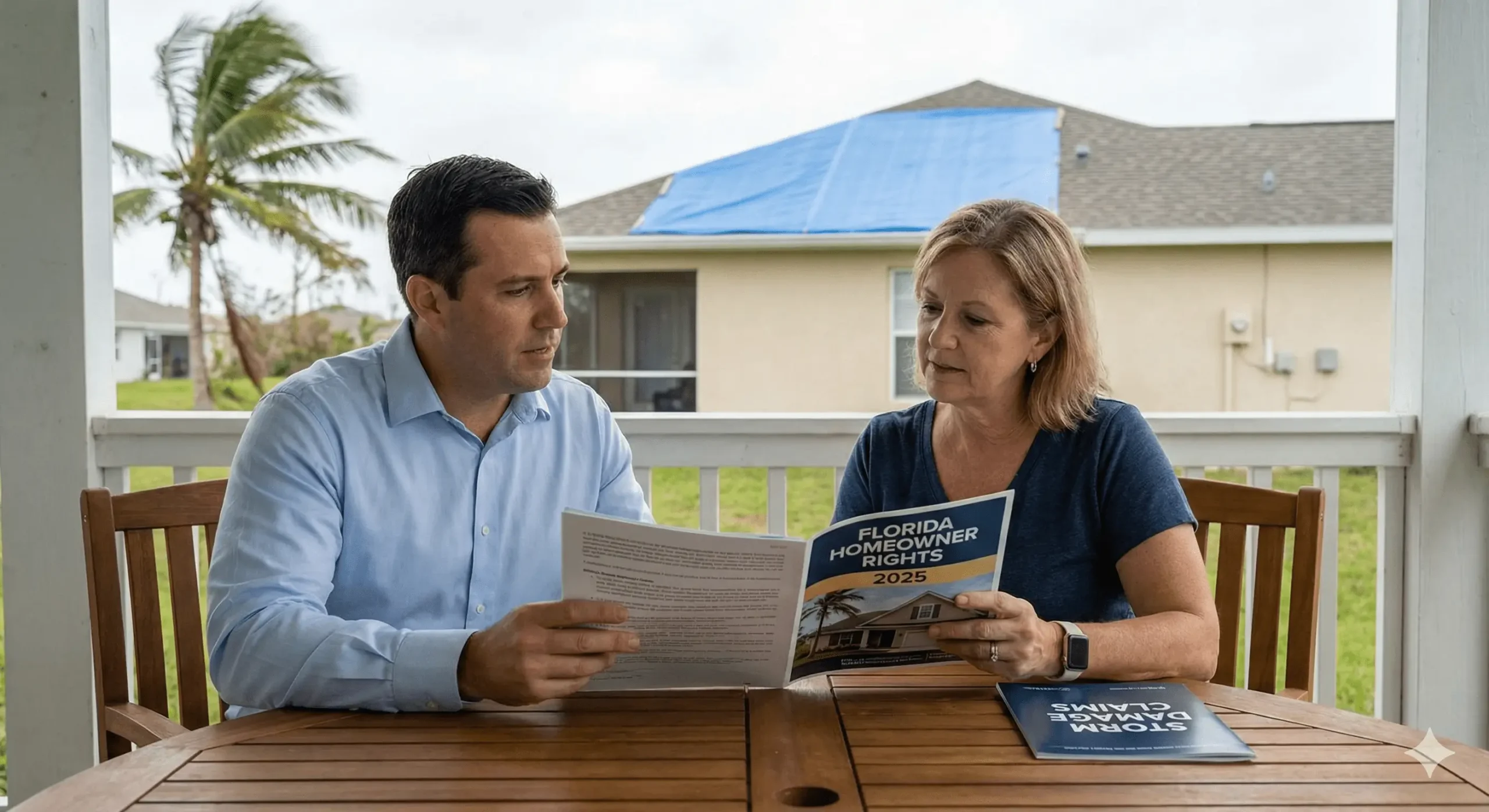
Florida storm damage laws changed significantly in 2022, and homeowners handling storm claims now face shorter notice deadlines and different claim procedures. the state rewrote its property insurance rules in December 2022, the deadlines got shorter, the fee protections got weaker, and most homeowners are still operating on the old rules. That knowledge gap costs real money after every storm, because the new system rewards whoever moves first and documents best, and the insurer already knows the rules.
Quick answer: Under Section 627.70132, Florida Statutes, a claim or reopened claim generally must be noticed within 1 year after the date of loss, while a supplemental claim generally must be noticed within 18 months. Section 627.70131, Florida Statutes sets timelines for insurer acknowledgment, investigation, and payment or denial of residential property claims, subject to the statute’s exceptions and circumstances beyond the insurer’s control. A lawsuit on the policy must be filed within 5 years of the date of loss. Hurricane damage carries a separate percentage deductible you chose at purchase, usually 2%, 5%, or 10% of your dwelling coverage.
Florida storm damage laws: key claim deadlines
- Notice of claim: 1 year from the date of loss. Hidden damage counts against the same clock, which is why post-storm inspections matter even when the house looks fine.
- Supplemental or reopened claims: 18 months from the date of loss. The second wave of damage you find during repairs answers to this window.
- The insurer’s clocks: acknowledge within 7 days, inspect within 30, pay or deny within 60 days of receiving a complete claim.
- Suit on the policy: 5 years from the date of loss under Section 95.11.
The date of loss anchors all four clocks, and disputes about it decide cases. A September hurricane, a February ceiling stain: the insurer will argue the loss date is September and start every clock there. Pin the date down with weather records, dated photos, and neighbor claims from the same storm, and dispute any insurer letter that states it wrong, immediately and in writing.
What SB 2A actually changed for homeowners
Florida’s December 2022 special session produced the biggest rewrite of property insurance law in a generation, and three changes matter most in practice. The notice window fell from 2 years to 1. One-way attorney fees, the rule that made insurers pay your lawyer when you won a coverage dispute, disappeared for new policies. And assignment-of-benefits agreements, where contractors took over your claim, were banned for policies issued after January 2023, putting homeowners back in direct control of their own claims, for better and worse.
The practical meaning: you can no longer sign your claim over to a roofer and walk away, and the economics of small coverage disputes changed. What survived untouched: your right to full payment under the policy, the insurer’s duty of good faith, the bad-faith remedy under Section 624.155, and every deadline the carrier has to meet. The system got stricter for everyone, and strictness punishes the unprepared side, which doesn’t have to be yours.
One more post-2022 reality check: several carriers left Florida or shed policies, pushing hundreds of thousands of homeowners onto Citizens or newer thinly-capitalized insurers. If your carrier went insolvent mid-claim, the Florida Insurance Guaranty Association steps in with its own caps and procedures, a wrinkle worth a legal review on any large open claim. And read your renewal each year, because deductibles, roof schedules, and appraisal clauses have been quietly rewritten across the market since the reform.
Hurricane deductibles: the check you write first
Hurricane damage runs through a separate deductible, a percentage of your dwelling coverage rather than a flat number. On a $400,000 dwelling limit, a 2% hurricane deductible means the first $8,000 comes out of your pocket; a 10% deductible means $40,000. The percentage was chosen when you bought the policy, usually as a premium trade-off nobody explained. Two details soften it: the hurricane deductible applies once per season, not per storm, so a second hurricane the same year runs against the remainder, and non-hurricane wind claims use your ordinary deductible instead. Check which deductible the adjuster applied; misclassification happens, and it’s worth thousands.
Roof claims: the fight Florida invented
Roofs drive more Florida storm litigation than everything else combined, and insurers price that reality into every roof decision they make. The recurring carrier moves: calling hurricane damage ‘wear and tear’ or ‘pre-existing,’ paying for a patch when matching rules and building code require more, applying a roof payment schedule that depreciates by age, and slow-walking inspections past the season’s next storm. Florida’s 25% rule changed in 2022: roofs built to the 2007 building code or later now need only repair to code rather than automatic full replacement when a quarter of the roof is damaged, which handed insurers a new partial-payment argument for older claims and made the roof’s construction date a key fact in yours.
Document the roof before storm season, every season: dated photos of every slope from the ground and, safely, from a ladder or drone. The before picture defeats the pre-existing argument better than any expert hired after the fact, and it costs ten minutes a year. If the carrier already said no, our guide to fighting a denied roof claim covers the appeal sequence step by step.
The proof of loss trap
Somewhere in the claim process, often folded into page three of a reservation-of-rights letter, the insurer demands a sworn proof of loss, usually within 60 days. Miss it and the carrier can deny an otherwise valid claim on timing alone, because courts treat the requirement as a condition of payment. The form, the deadlines by policy type, and the extension rules get full treatment in our proof of loss deadline guide. The one-line version: calendar the date the moment the request arrives, and file complete or file what you have.
Wind versus flood: the coverage line that decides everything
Homeowner’s policies cover wind. They exclude flood, which only NFIP or private flood policies cover, and hurricane damage routinely involves both at once. Expect the wind carrier to attribute damage to storm surge and the flood carrier to attribute it to wind, each pointing at the other while your contractor waits. The counter is causation evidence gathered early: water lines on walls, the direction of debris, meteorological data on when surge arrived versus when the roof opened. Homes near the coast should photograph interior water heights before cleanup, because that single measurement often allocates the claim. Flood claims also carry the strictest deadline in this entire area, a 60-day federal proof of loss, covered in the guide linked above.
Condo owners: two policies, two fights
Condo damage splits between the association’s master policy, which covers the building’s structure and common elements, and your HO-6 policy, which covers your unit’s interior from the drywall in. Storm damage that crosses that line, a roof failure that soaks three floors of units, produces simultaneous claims with both insurers pointing at the other’s policy. Association deadlines and your own run separately. Our Florida condo damage guide maps the owner-versus-HOA split in detail.
What underpayment looks like in practice
Denial gets the headlines; underpayment takes the money. A worked example from the pattern we see constantly: hurricane damage with a contractor’s estimate at $86,000, an insurer scope at $41,000, and a check for $33,000 after the $8,000 hurricane deductible. The gap hides in line items: depreciation applied aggressively, matching costs for siding and shingles omitted, code-upgrade costs excluded despite ordinance coverage, drying and mitigation underpriced against the invoices you already paid. Each line looks defensible alone. Together they take half the claim. Reading the insurer’s estimate line by line against your contractor’s, and against the policy’s actual language on matching and ordinance coverage, is where a storm claim recovers its missing half, and it’s the least glamorous, highest-value work in this practice.
Mediation and appraisal: the middle paths
Two dispute routes sit between accepting a lowball and filing suit. Florida’s Department of Financial Services provides a residential property insurance mediation program for eligible claim disputes, offering policyholders a nonbinding process outside of court. The appraisal clause in most policies is the second path, where each side names an appraiser, the appraisers pick an umpire, and the panel sets the loss amount, binding on the number though never on coverage questions. Appraisal resolves scope fights faster than litigation, and carriers know it, which is why some policies quietly narrowed their appraisal clauses in recent renewals. Which path fits depends on whether the fight is about how much, or about whether: pure amount disputes suit appraisal, coverage denials need the legal route.
When the insurer acts in bad faith
Deadlines missed, inspections skipped, lowballs renewed without explanation, misrepresentations about what the policy covers: Florida law calls that bad faith, and Section 624.155 gives policyholders a remedy that can exceed the policy limits. The procedure is specific, starting with a civil remedy notice that gives the carrier 60 days to cure, and the claims that win are built on a documented record of every insurer failure along the way. Keep every letter, log every call with date and adjuster name, and put every dispute in writing. The file you build during the claim is the bad-faith case later.
Public adjusters, contractors, and lawyers: who does what
Three professionals orbit every storm claim, and homeowners routinely hire the wrong one first. A public adjuster documents and negotiates the claim for a percentage of the payout, capped by Florida law, and earns it on complex scope disputes where the fight is measurement rather than law. A contractor prices the repair and, since the AOB ban, can no longer take over your claim, so treat any contractor pushing paperwork beyond an estimate with suspicion. A lawyer belongs in the picture when coverage is denied, when the proof of loss or deadline traps have been sprung, when bad faith is accumulating, or when the underpayment justifies the fight. The sequencing matters because fees stack: a public adjuster’s percentage plus legal fees on the same recovery needs to make sense before you sign both agreements, and an honest professional in any of the three roles will tell you which of the others you actually need.
What to do after the storm, in order
- Photograph and video everything before touching anything: every room, the roof from the ground, the yard, the water lines.
- Make only the temporary repairs needed to prevent further damage, and keep every receipt. Your policy requires mitigation and pays for it.
- Report the claim in writing immediately, and note the claim number and the date. The 1-year window feels generous right up until hidden damage surfaces in month eleven.
- Meet the field adjuster with your own documentation, and get your own contractor’s estimate independently. The adjuster’s scope is a first draft written by the other side.
- Answer the proof of loss demand on time, complete, notarized where required, and sent by certified mail with the receipt kept.
- Before accepting any settlement, have the numbers reviewed line by line against your contractor’s estimate. Underpayment, quiet and defensible-looking, is how most Florida storm claims lose money, and a review costs you nothing.
- Keep living-expense receipts if the home is unlivable. Loss-of-use coverage pays for the hotel and the takeout, and homeowners forget to claim it every single storm.
Cases we take
We take Florida storm and hurricane cases where real money sits in dispute: denials, underpayments well past the deductible, roof claims called wear-and-tear, wind-versus-flood allocation fights, condo cross-policy claims, and proof-of-loss technicality denials. Our Florida property damage team works these on contingency. A claim underpaid by an amount near your deductible gets honest advice instead: work the internal appeal first, and come back if the carrier stops moving.
Talk to us before the next deadline
Jack Vasilaros built United Law Group on straight answers, and storm claims reward exactly that. Bring the denial or the lowball estimate to a free case evaluation or call 727-306-3324, and we’ll tell you in one conversation whether the carrier’s number holds up.
Frequently Asked Questions
What is the time limit for storm damage roof claims in Florida?
One year from the date of loss to report the claim under Section 627.70132, and 18 months for supplemental claims. The lawsuit deadline is 5 years from the date of loss. Hidden roof damage counts against the same one-year clock, so post-storm inspections matter.
How long does my insurer have to pay a hurricane claim in Florida?
Sixty days from receiving a complete claim to pay or deny, under Section 627.70131, with a 7-day acknowledgment and 30-day inspection requirement along the way. Your complete, on-time proof of loss is what starts the payment clock.
How does the hurricane deductible work?
As a percentage of your dwelling coverage, typically 2%, 5%, or 10%, applied once per hurricane season rather than per storm. On $400,000 of coverage, a 2% deductible means the first $8,000 is yours. Non-hurricane wind uses your regular deductible instead.
How much does a lawyer cost for property damage claims?
We work storm cases on contingency: nothing up front, the percentage in writing before you sign, no recovery means no fee. SB 2A ended one-way fee awards for new policies, which makes case selection matter more, and we’re straight about which disputes justify counsel.
What if my damage is from both wind and flood?
Two policies respond: your homeowner’s policy for wind and a flood policy for surge, and each insurer tends to blame the other’s peril. Causation evidence gathered early, water lines, debris direction, storm timing data, is what allocates the claim fairly.
Can I sue my insurance company for acting in bad faith?
Yes, under Section 624.155, after filing a civil remedy notice that gives the carrier 60 days to cure. Bad-faith recoveries can exceed policy limits, and the case is built from the documented record of the insurer’s failures during the claim.
Get a Free Case Review
Send us the estimate, the denial letter, or the check that looked too small, and we’ll tell you in one conversation whether the carrier’s number survives scrutiny. No fee unless we recover.