
Florida Truck Accident Settlement Amounts
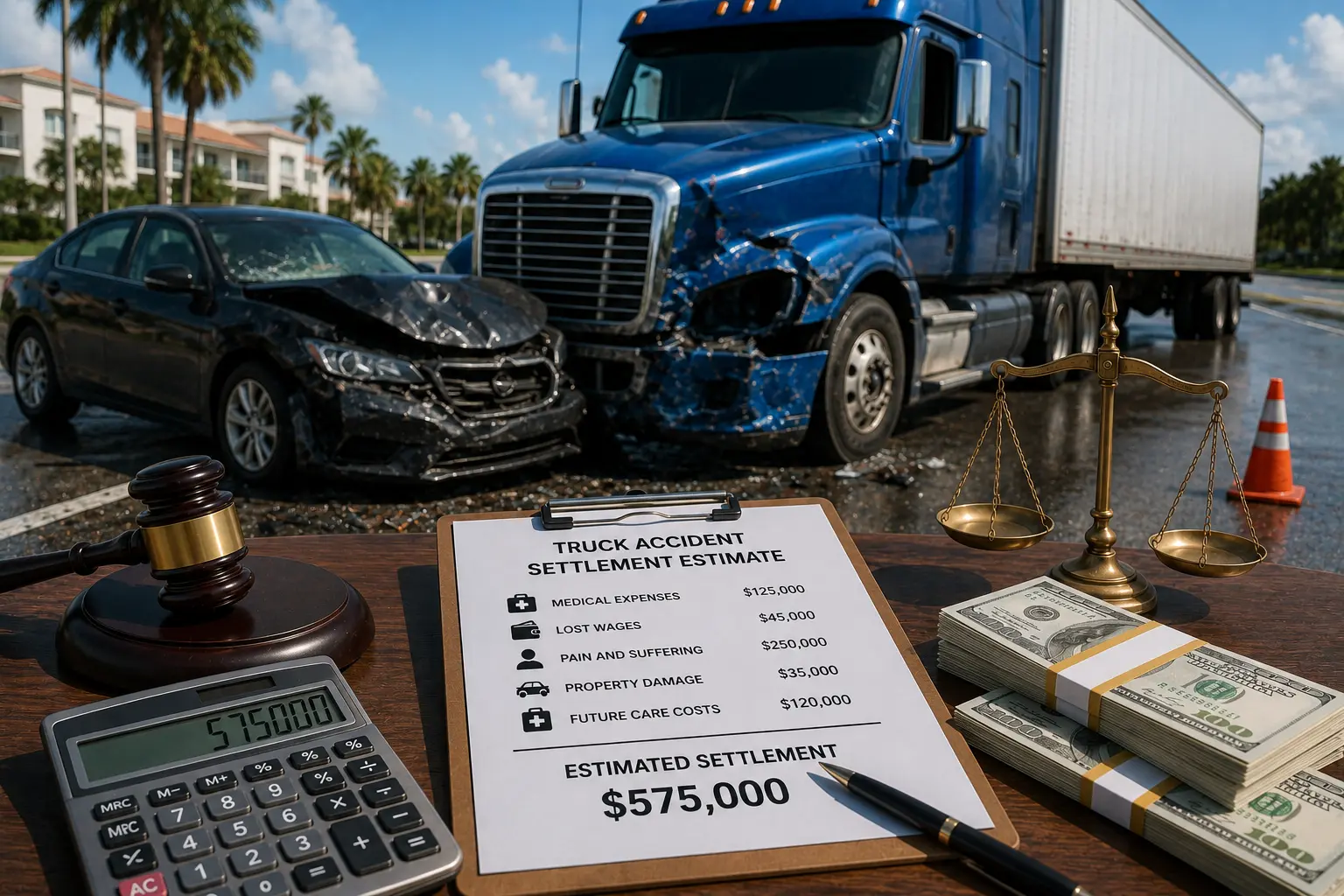
If you are searching for the typical Florida truck accident settlement, you want a number, and the honest answer is that truck cases sit in a different league than car crashes. The injuries are worse, the insurance is bigger, and more parties can be on the hook.
Below we break down what drives value, realistic ranges by injury, and what raises or lowers a payout. For how these claims are built, see our Florida truck accident lawyers page.
Why Truck Settlements Outsize Car Claims
A truck claim and a car claim can involve the same intersection and the same kind of crash, yet settle worlds apart. The difference comes down to three things: the size of the injuries, the size of the insurance, and the number of parties who can pay.
A loaded 18-wheeler weighs 20 to 30 times what a car weighs, so when it hits a passenger vehicle the injuries are routinely catastrophic. More severe injuries mean higher medical bills, more lost income, and larger pain-and-suffering damages, all of which push the value up.
Florida sees heavy truck traffic on I-95, I-4, I-75, and the Turnpike, mixing long-haul freight with dense tourist and commuter traffic. That combination produces serious wrecks, and it also means the trucking companies and insurers on the other side handle these claims constantly and know exactly how to minimize them. A claim built to match that sophistication recovers far more than one a frustrated victim pursues alone.
The insurance gap is just as important. A typical Florida driver may carry only minimal coverage, while federal law requires most freight carriers to hold at least $750,000, and up to $5,000,000 for hazardous loads, under FMCSA insurance requirements. That larger policy is often what makes a full recovery possible.
The third factor is the number of parties who can pay. A car crash usually means one at-fault driver and one insurer. A truck crash can involve the driver, the trucking company, a freight broker, a maintenance shop, and a cargo loader, and each can carry its own coverage. More responsible parties means more available money, which lifts the realistic settlement range well above what a single-policy car claim can reach.
Hurt in a Florida truck crash? Call (727) 306-3324 or request a free case evaluation.
What Drives a Truck Case’s Value: Injuries, Policies, Defendants
Three factors do most of the work in setting a truck settlement, and each one can be built up with the right evidence:
- Injury severity, including whether the harm is permanent
- Total medical bills, now and in the future
- Lost wages and reduced earning capacity
- How many policies and defendants are available to pay
- How clearly the driver or carrier was at fault
Severity sets the ceiling, but coverage decides whether you can reach it. A catastrophic injury is only worth its full value if there is enough insurance to pay, which is why finding every applicable policy matters as much as proving the injury. A million-dollar injury against a single small policy still only collects that policy unless other defendants or your own coverage can be brought in.
Multiple defendants expand the pool. The driver, the trucking company, a broker, a maintenance shop, and a cargo loader can each carry coverage, and commercial crashes hide policies that are easy to miss. Our guide on hidden commercial insurance policies explains where that extra coverage lives.
Proof is the quiet fourth factor. Two cases with identical injuries can settle far apart based on how well the fault and the damages are documented. A clean liability picture, supported by the truck’s own data and the federal records, gives the insurer far less room to discount the claim, while a thin file invites a lowball offer.
Economic vs Non-Economic Damages
Florida splits your recovery into two buckets, and a full truck claim captures both. Economic damages are the losses with a number attached, and non-economic damages cover the human toll.
- Economic: medical bills, future care, lost wages, lost earning capacity, property damage
- Non-economic: pain, suffering, disfigurement, and loss of enjoyment of life
In serious truck cases the future-care and lost-earning-capacity pieces often dwarf the immediate bills. A spinal or brain injury can mean years of treatment and a permanent change to what you can earn, and a settlement has to account for all of it because you cannot reopen it later. We frequently bring in medical and vocational experts to project those long-term costs, because the carrier will not volunteer them.
Non-economic damages are where strong documentation pays off most. Medical records, a treating doctor’s findings on permanent limits, and testimony about how the injury changed daily life all push the value up. Our guide to how Florida values injury claims covers the categories in detail.
How Commercial Policy Limits and Multiple Defendants Expand Recovery
The single biggest reason truck settlements run high is the layered coverage. Where a car claim might be capped at a small personal policy, a truck claim can reach a seven-figure commercial policy, and sometimes more than one.
Layering defendants is how that potential gets unlocked. If the driver, the carrier, and a negligent broker each share responsibility, each one’s coverage can contribute, and the total available money climbs well past any single policy. The investigation into who is responsible is therefore an investigation into how much can be recovered, which is why we treat the two as one and the same.
Untangling that web takes work, because ownership, leasing, and broker arrangements in trucking are often deliberately complex, with the driver, the tractor, the trailer, and the freight tied to different companies. We follow the threads to every party that owes a duty, since the one a carrier hopes you overlook is sometimes the one with the deepest pockets.
Your own coverage can add to the total too. If the at-fault parties together still fall short of your losses, uninsured and underinsured motorist coverage on your policy can stack on top to help close the gap. We check every policy in your household, because that extra layer sometimes turns a partial recovery into a full one.
Not sure how much coverage applies to your crash? Call (727) 306-3324 or request a free case evaluation.
The Serious-Injury Threshold and Comparative Negligence
Two Florida rules shape the number. First, if you were in a car when the truck hit you, your own PIP pays the first $10,000 under Florida Statute 627.736, but to recover full damages from the trucking company you must clear the serious-injury threshold in Florida Statute 627.737. Catastrophic truck injuries almost always clear it.
Second, since House Bill 837, Florida uses modified comparative negligence with a 51% bar. If you are more than half at fault you recover nothing, and below that your award drops by your share. Florida Statute 95.11 gives you two years to file.
Comparative fault is where the carrier fights hardest, because every percentage point it shifts onto you comes off the settlement. The federal safety rules help here: a logbook showing too many hours or a skipped inspection can pin fault squarely on the driver and carrier, which protects your share and your recovery.
The threshold also explains why the medical record matters so much to value. A clearly permanent injury, documented by your treating doctors, both clears the bar to sue the trucking company and supports the larger pain-and-suffering damages that make truck cases worth what they are. Thin or gap-filled records do the opposite, handing the insurer an argument to keep you capped at PIP.
Sample Settlement Ranges by Injury Severity
Every case turns on its own facts, so treat these as general guides, not promises. Based on how Florida truck claims commonly resolve:
- Moderate injuries with full recovery: often tens of thousands to low six figures
- Serious injuries needing surgery: commonly $200,000 to $500,000
- Permanent or catastrophic injuries: frequently $1 million or more
- Wrongful death and multi-defendant cases: often the highest, limited mainly by coverage
Notice how fast the numbers climb with severity and coverage. A claim against a single small policy stalls at that limit, while the same injury against a carrier, an owner, and a broker can reach the full measure of the loss.
It helps to see how a number is built. A serious case might combine $150,000 in medical bills, a year of lost wages, future treatment, and pain-and-suffering damages that reflect a permanent limitation, landing in the mid-six figures. A catastrophic case adds lifelong care and lost earning capacity, which is what pushes it past a million when the coverage is there to pay it.
Averages mislead here, because a handful of multi-million-dollar verdicts drag the statistical average far above a typical case. Your own facts, your injuries, and the coverage you can reach tell you far more than any average.
Be wary of any number promised before the facts are in. An honest estimate comes only after a lawyer reviews your medical records, the police report, the federal records, and the available policies. Anyone who guarantees a figure from a website or a first phone call is guessing, and usually guessing low.
What Lowers Your Payout
Several things can shrink a truck settlement, and most are avoidable or answerable:
- Gaps or delays in medical treatment that let the insurer argue you healed
- A recorded statement given before a lawyer reviews it
- Missing the 14-day PIP deadline after a crash in your own car
- Letting the truck’s black box and logs get erased before they are preserved
- Accepting the first offer before the full injury picture is clear
The evidence point is the one unique to truck cases. Electronic logs can be overwritten in weeks, and carriers must keep them for only six months, so a fast preservation demand often decides how strong the case, and the settlement, can be.
Settling too early is the costliest mistake of all. Trucking insurers often make a fast offer while you are still in treatment, betting you will take relief now over full value later. Once you sign a release, the claim is closed for good, even if your injuries turn out to be far worse than they first seemed.
Each of these hands the insurer a reason to pay less, and some are hard to undo. Avoiding them protects the value the case already has, which is why a free review before you respond to any offer is worth the call.
Worried the trucking company is shifting blame? Call (727) 306-3324 or request a free case evaluation.
How We Maximize Truck Recovery
Maximizing a truck settlement comes down to a few disciplined steps: preserve the evidence fast, identify every liable party and policy, build the medical and economic proof, and prepare the case for trial so the carrier takes it seriously. Our Clearwater trucking accident page shows how we handle these locally.
Because coverage sets the ceiling, the coverage search is one of the first things we do, not the last. We send preservation letters the day you call, pull the federal records, and pursue the driver, the carrier, the broker, and anyone else who shares the blame.
We also build the case as if it is going to trial from the start, because that is what moves a large carrier off a lowball number. A demand backed by the truck’s data, the federal-rule violations, and a fully documented medical picture is one the insurer cannot easily dismiss, and the credible threat of a courtroom does the rest.
The goal is the net result in your pocket, so we also negotiate medical liens at the end so more of the settlement reaches you. Owner Jack Vasilaros reviews these cases personally, and the consultation is free.
How United Law Group Can Help
We value the claim properly, find the coverage that sets the ceiling, and fight for the full amount rather than the insurer’s first offer. With a truck case, the early evidence work and the coverage search are often what make or break the recovery.
We work on contingency, so there is no upfront cost and no fee unless we win. We advance the costs of building the case, including the experts these claims demand, and the consultation is always free with no obligation to hire us. Jack’s got your back from the first call to the final check.
What is the average truck accident settlement in Florida?
Florida truck settlements often fall in the $200,000 to $500,000 range, with serious cases climbing past $1 million. Because rider and occupant injuries in truck crashes tend to be severe, an average is misleading, and value depends on the injury, coverage, and proof.
Why are truck settlements bigger than car settlements?
Trucks carry far larger insurance, federal law requires at least $750,000 and up to $5 million, the injuries are more severe, and multiple parties can be liable. Those three factors push truck values well above a typical car claim.
Who can I recover from after a truck crash?
Often more than one party: the driver, the trucking company, a freight broker, a maintenance provider, or a cargo loader. Each can carry coverage, and layering them expands the money available to pay your claim.
How long do I have to file in Florida?
Two years from the crash for incidents on or after March 24, 2023. With truck cases, the federal records and black-box data can disappear far sooner, so acting quickly also protects your evidence.
Does my PIP apply if a truck hit my car?
Yes. Your PIP pays the first $10,000 in medical bills regardless of fault if you get care within 14 days. For the rest, you pursue the trucking company once your injury clears the serious-injury threshold.
What lowers a truck accident settlement?
Treatment gaps, a recorded statement given too early, missing the 14-day PIP deadline, lost black-box evidence, and accepting the first offer all reduce value. Most are avoidable with early legal help.
How much does a truck accident lawyer cost?
Nothing upfront. We work on contingency, advance the case costs, and collect a fee only if we win. The consultation is free.