
Florida Used-Car Lemon Law: What You’re Actually Owed
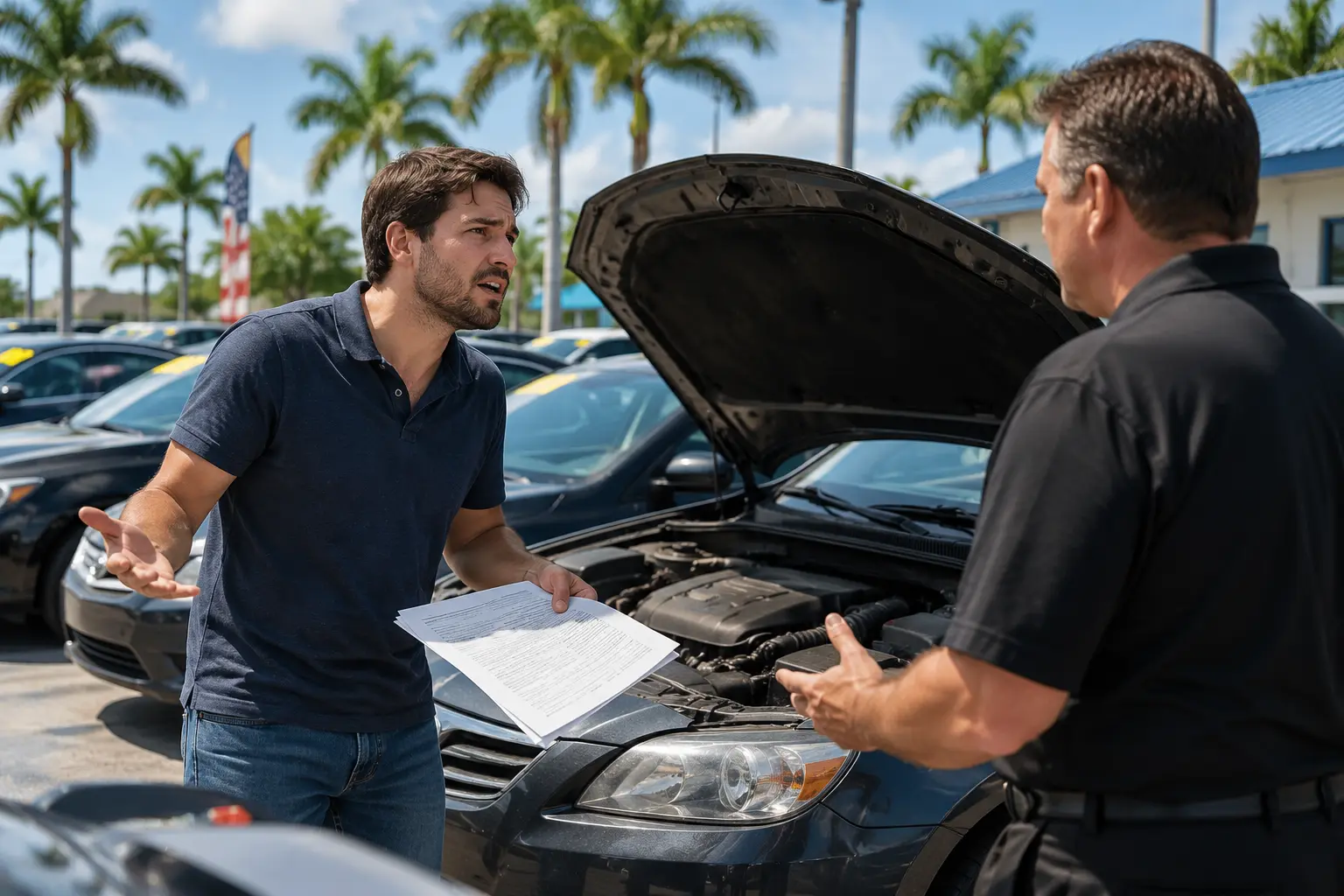
Searching for the Florida used car lemon law usually ends in the same disappointment, so here it is straight: Florida has no lemon law for used cars. Chapter 681 covers new and demonstrator vehicles, and the dealer who shrugged at your dead transmission knows it. What dealers count on is you stopping there. Five other legal routes force refunds, repairs, and damages for defective used cars in Florida, and the right one depends on how you bought and what went wrong.
Quick answer: The Florida Lemon Law excludes used cars, with one exception: a vehicle still inside its original 24-month Lemon Law rights period keeps those rights when it changes hands. Past that, your remedies are the federal warranty act for cars sold with a written warranty, the implied warranty of merchantability, FDUTPA deceptive practices claims, common-law dealer fraud, and odometer fraud laws. ‘As is’ on the buyer’s order narrows your options but kills fewer claims than dealers pretend.
The one exception: used cars still inside the 24-month window
Chapter 681’s rights period runs 24 months from the vehicle’s original delivery date, and Section 681.102 defines ‘consumer’ to include anyone the vehicle is transferred to during that period. Buy a two-year-old car from its first owner at month 20, and you inherit four months of full Lemon Law rights, including the buyback remedy. The question is never whether the car is used. The question is the date on the original delivery paperwork. Our Florida Lemon Law guide walks through how that clock and the repair-attempt rules work.
Route 1: The federal warranty act, the closest thing to a used-car lemon law
The Magnuson-Moss Warranty Act is federal law covering any consumer product sold with a written warranty, and used cars qualify constantly: the balance of the factory warranty, a certified pre-owned warranty, a dealer’s 30-day or 3,000-mile warranty, even a service contract sold with the car. When a warranted defect doesn’t get fixed after a reasonable number of attempts, the act supports refund or damages claims, and its best feature does the heavy lifting: a winning consumer recovers attorney’s fees from the other side. That fee-shifting provision is why lawyers can take used-car cases that would otherwise cost more to fight than the car is worth.
Route 2: The implied warranty of merchantability
Florida law implies a promise into most dealer sales: the car has to actually work as basic transportation. A vehicle that leaves the lot with a failing transmission breaches that implied warranty whether or not anyone wrote anything down. Two catches matter. Private sellers don’t make this warranty, only merchants do. And dealers can disclaim it with conspicuous ‘as is’ language, which is exactly why that phrase appears on so many buyer’s orders. One more federal wrinkle helps: when the dealer sold you a written warranty or service contract, Magnuson-Moss blocks them from disclaiming the implied warranty underneath it. Plenty of ‘as is’ deals aren’t really as-is once the paperwork gets read properly.
Route 3: FDUTPA, when the deal itself was deceptive
The Florida Deceptive and Unfair Trade Practices Act, Part II of Chapter 501, reaches the sale rather than the car. Rolled-back odometers, concealed flood or frame damage, ‘certified’ cars that were never inspected, undisclosed salvage history, financing bait-and-switch: all of it lives under FDUTPA. The act supports actual damages and, like the federal warranty act, lets a winning consumer recover attorney’s fees. ‘As is’ doesn’t shield deception. Selling a flood car without disclosure is deceptive whether or not the buyer signed a waiver, because the waiver covers the car’s condition, never the dealer’s lies about it.
Route 4: Dealer fraud and misrepresentation
When a dealer knew about a defect and hid it, or made claims they knew were false, common-law fraud comes into play alongside FDUTPA. Fraud claims can reach punitive damages, which changes settlement conversations fast. The proof lives in paper: the vehicle history report the dealer pulled and didn’t show you, the auction condition report, the wholesale inspection notes. Getting that paper takes legal discovery, which is one honest reason these claims go better with counsel than without.
Route 5: Odometer fraud
Federal odometer law requires accurate mileage disclosure on title transfer and provides treble damages or statutory minimums for violations, plus attorney’s fees. Digital odometers made rollbacks easier, not harder, since a cheap tool rewrites the display while the truth stays burned into other control modules. Florida’s used-car volume makes it a steady problem. Service records, title history, emissions and inspection data, and the mileage stamped on old oil-change stickers usually expose the gap, and a scan of the vehicle’s modules settles it.
Certified pre-owned: the label that promises an inspection
CPO programs sell peace of mind: a multi-point inspection, a manufacturer-backed warranty, a higher price to match. When a certified car turns out to have frame damage or an open recall the inspection should have caught, the certification itself becomes the case. You paid a premium for a documented process, and either the inspection never happened as described, which runs into FDUTPA and fraud territory, or the warranty applies and the federal warranty act enforces it. Ask the dealer for the actual inspection checklist for your vehicle. Refusal to produce it tells you most of what you need to know.
Flood cars: Florida’s recurring special
Every hurricane season pushes thousands of flooded vehicles into the resale market, dried out, detailed, and retitled through states with looser branding rules. Saltwater damage hides in wiring harnesses and shows up months later as cascading electrical failures. Warning signs: carpet that smells musty or looks newer than the car, silt in seatbelt tracks or under the spare tire, corrosion on seat rails and door hinges, and a title that hopped states shortly after a storm. Concealing a flood history is a textbook FDUTPA violation, and these cases settle strong because the concealment is provable from title records and repair patterns.
Buy-here-pay-here lots and financing games
The lower end of the market produces its own claim patterns. Buy-here-pay-here lots sell aging inventory at high interest to buyers with few alternatives, and some pair mechanical problems with aggressive repossession the moment a payment slips. Yo-yo financing is the other classic: you drive home, the dealer calls a week later claiming the financing ‘fell through,’ and the new deal carries a higher rate and your trade-in is already gone. Both patterns generate FDUTPA and fraud claims, and repossession abuse can add its own causes of action. Keep every text and voicemail; these cases are built from exactly that trail.
The two myths that kill good claims
Myth one: ‘Florida has a cooling-off period, I can return it within three days.’ No such right exists for car purchases in Florida. The federal cooling-off rule covers door-to-door sales, never dealer lots. Once you sign, the car is yours unless a legal claim says otherwise, so none of the routes above works as a buyer’s-remorse exit.
Myth two: ”As is’ means I have no rights at all.’ As-is language disclaims the implied warranty of merchantability, and that’s all it does. It doesn’t erase a written warranty you paid for, doesn’t block FDUTPA deception claims, doesn’t excuse fraud, and doesn’t touch odometer law. Dealers lean on those two words precisely because most buyers never learn their actual limits.
What to do if a dealership sold you a bad used car in Florida
- Stop driving the car if the defect is safety-related, and get an independent mechanic’s written diagnosis, meaning a shop with no relationship to the selling dealer. That report becomes the foundation of every route above.
- Gather the paper: buyer’s order, financing contract, warranty or service contract, advertisements or listings, texts with the salesperson, and the window sticker if you photographed it.
- Pull the vehicle’s history yourself: title records, prior state registrations, auction history if reachable. Gaps between what the dealer said and what the records show are the case.
- Give the dealer one written chance to fix or unwind the deal, by email so it’s dated. Some fold here to protect their reviews and their license; the rest just handed you dated evidence that they knew and did nothing, which strengthens every route above.
- Talk to a consumer attorney before small claims court. Fee-shifting under Magnuson-Moss and FDUTPA means real cases cost you nothing to bring, and lawyered demand letters read differently to a dealership’s general manager.
How long you have to sue
Deadlines vary by route, which is one more reason to have the paperwork reviewed early. Breach of warranty claims under Florida’s commercial code generally run four years from delivery of the car, not from when the defect surfaced. FDUTPA claims carry a four-year window. Fraud claims run from discovery of the deception, with outer limits. None of those clocks pauses while you argue with a service manager, and dealers who sense a deadline approaching suddenly get very slow at returning calls. If your car troubles started more than a year ago, treat the timeline review as urgent rather than administrative.
The paper trail that wins these cases
Used-car cases are document cases. Assemble this folder before your consultation and you cut weeks off the process:
- The buyer’s order and every signed sale document, including the as-is disclosure if there was one
- The written warranty, CPO certificate, or service contract, whichever you were sold
- The listing or ad for the car, screenshotted, plus texts and emails with the salesperson
- Your independent mechanic’s written diagnosis with an estimate
- Every repair order since purchase, including visits where the dealer found nothing
- The title history and any vehicle history report, yours or the dealer’s
The single most valuable item is usually the dealer’s own words in writing. A text saying ‘never been in an accident’ next to a body-shop repair record ends most negotiations quickly.
Missing documents aren’t fatal, just slower. Dealers must keep deal jackets, lenders keep the financing file, and repair chains keep records searchable by VIN. Legal discovery reaches all of it, including the auction condition report from when the dealer bought the car, which frequently says in plain type exactly what the salesperson later denied knowing. Buyers rarely see that report. Lawyers subpoena it as a matter of routine.
What these cases are worth
Used-car claims price differently than injury cases. The measure is usually the difference between what you paid and what the defective car was actually worth, plus repair costs, towing, rental, and loan interest tied to the deal. Fraud cases add punitive exposure. Fee-shifting changes the economics more than any single damage category: a $12,000 claim becomes worth fighting when the dealer faces paying both sides’ lawyers. Typical outcomes run from a few thousand dollars in repair-cost settlements to full buybacks with the loan paid off, and flood and salvage concealment cases routinely land at the higher end.
Cases we take, and cases we’ll talk you out of
We take Florida used-car cases with documented defects or deception and real money at stake: concealed flood, frame, or salvage history, warranty repairs the dealer won’t honor, certified cars that were never inspected, odometer discrepancies, and financing switches. We’ll also tell you when you don’t need us: a $900 repair on an honest as-is sale belongs in small claims or a negotiation, and we’ll point you at the right form instead of billing you. Broader scam patterns live in our Florida consumer protection practice, and Texas buyers have parallel rights under our Texas Lemon Law guide.
How United Law Group handles used-car cases
Our consumer protection attorneys read the deal paperwork first, because the buyer’s order and warranty documents usually decide which of the five routes fits. Fee-shifting statutes mean most viable cases cost you nothing out of pocket. Jack Vasilaros built the firm on straight answers, and the first one is free: send us the paperwork and we’ll tell you whether you have a case.
Start with a free case evaluation or call 727-306-3324. Have the buyer’s order and the mechanic’s diagnosis handy.
Frequently Asked Questions
Does Florida have a lemon law for used cars?
No. Chapter 681 covers new and demonstrator vehicles only. The single exception: a used car still inside its original 24-month Lemon Law rights period carries those rights to the new owner. Other laws, including the federal warranty act and FDUTPA, cover used-car defects and deception instead.
What do I do if a dealership sold me a bad used car in Florida?
Get an independent mechanic’s written diagnosis, gather every document from the sale, pull the vehicle’s title history, give the dealer one written chance to fix it, and talk to a consumer attorney. Fee-shifting laws mean strong cases usually cost you nothing to bring.
Can I sue a dealership for selling me a lemon used car?
Yes, when the facts support it: breach of a written or implied warranty, FDUTPA deception, fraud, or odometer violations. The claim depends on what the dealer knew, said, and put in writing, not on the Lemon Law itself.
How long do I have to return a used car in Florida?
There is no return window. Florida has no cooling-off period for vehicle purchases, and the sale is final at signing. Unwinding a deal requires a legal claim, which is why documentation of defects and deception matters so much.
Does ‘as is’ mean I have no rights?
No. As-is language disclaims the implied warranty of merchantability and nothing else. Written warranties you purchased, FDUTPA deception claims, fraud, and odometer law all survive an as-is sale.
Who pays the lawyer in a used-car case?
Often the dealer. The Magnuson-Moss Warranty Act, FDUTPA, and federal odometer law all let a winning consumer recover attorney’s fees from the other side, which is what makes modest-value car cases economically possible to fight.
Get a Free Case Review
Email us the buyer’s order, the warranty paperwork, and the mechanic’s diagnosis, and we’ll tell you in one conversation which route fits and whether it’s worth pursuing. Most viable cases cost you nothing out of pocket.