
Texas DTPA Treble Damages: How Consumer Lawsuits Work
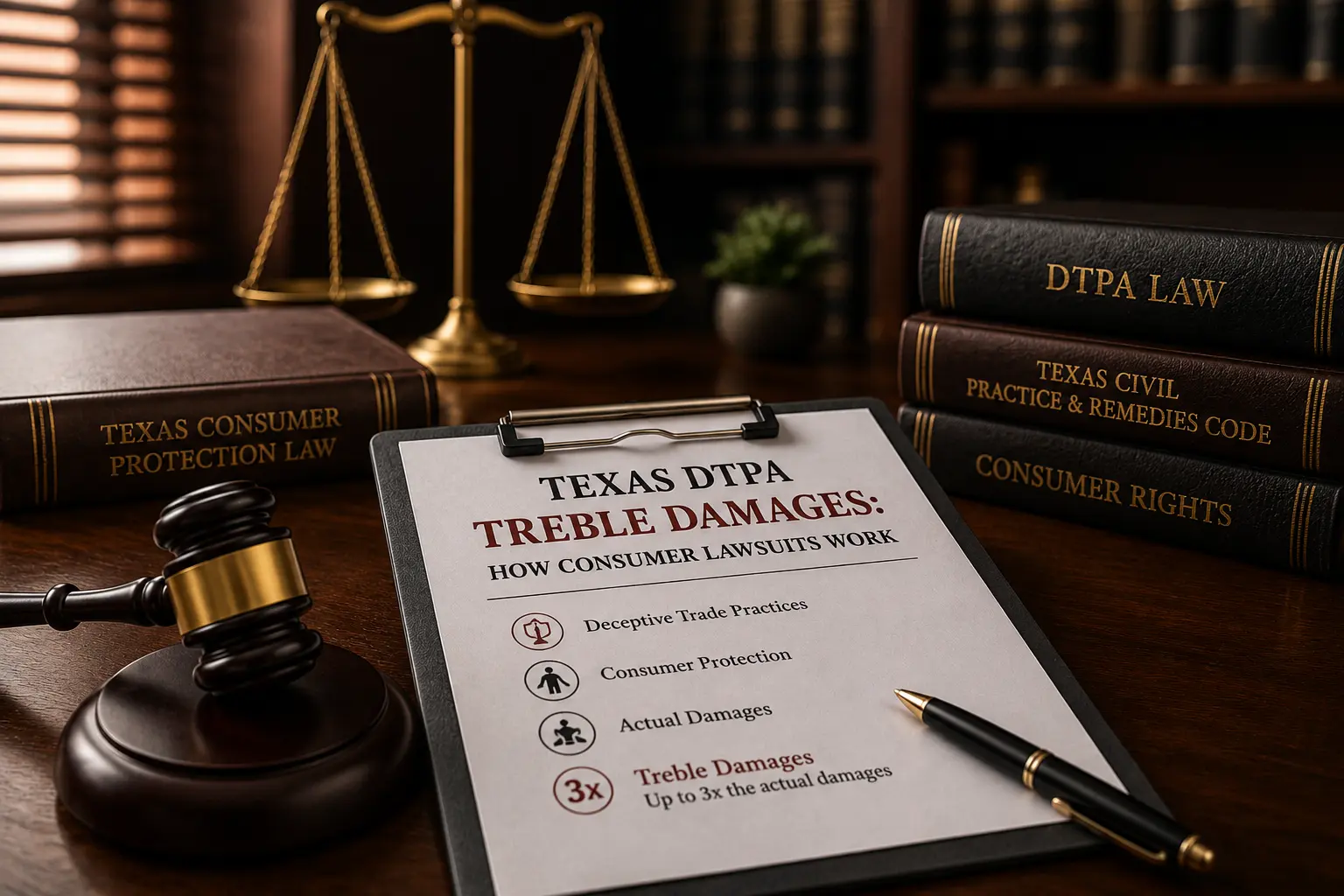
Treble damages under the Texas Deceptive Trade Practices Act (DTPA) let consumers recover up to three times their economic damages plus mental anguish damages, attorney fees, and court costs when a business knowingly engaged in deceptive conduct. Treble damages require proof of knowing violation under Tex. Bus. & Com. Code 17.50(b)(1), not just simple deception. Before filing, you must send a 60-day pre-suit notice letter under Tex. Bus. & Com. Code 17.505 specifying the complaint and damages. The DTPA statute of limitations is two years from when the deceptive act occurred or should have been discovered. Most DTPA cases settle pre-suit because the treble-damages exposure plus mandatory attorney fees changes the defendant’s math fast.
Free case review. Cheated, defrauded, or misled by a Texas business? We tell you whether DTPA applies in 24 hours.
Tell us what the business did and what it cost you. We will tell you whether DTPA gets you treble damages.
What the Texas DTPA Covers
The Texas Deceptive Trade Practices Consumer Protection Act (Tex. Bus. & Com. Code Chapter 17, sections 17.41 through 17.63) is one of the most powerful consumer protection statutes in the country. It was passed in 1973 to protect Texas consumers from unscrupulous sellers of goods and services. The DTPA creates a private cause of action for consumers, with mandatory attorney fees for prevailing plaintiffs and treble damages exposure for defendants who acted knowingly.
Who Counts as a Consumer Under DTPA
A consumer is a person who seeks or acquires goods or services by purchase or lease, with the goods or services being the basis of the complaint. Businesses with assets under $25 million can also qualify as consumers. The transaction must involve goods or services, not pure money or securities. Real estate purchases, vehicle sales, home repair contracts, and most consumer transactions fall under DTPA. Pure investment fraud and stock purchases generally do not.
The Laundry List Violations (17.46(b))
Tex. Bus. & Com. Code 17.46(b) lists specific deceptive practices. The list runs over 30 specific categories. Common DTPA violations we see include:
- Passing off goods or services as those of another (counterfeit or misrepresented brand)
- Causing confusion about the source, sponsorship, approval, or certification of goods or services
- Representing that goods are new when they are used, reconditioned, or rebuilt
- Representing that goods or services have characteristics, ingredients, uses, benefits, or qualities they do not have
- Advertising goods or services with intent not to sell them as advertised (bait-and-switch)
- Failing to disclose information about goods or services with intent to induce the consumer to enter into a transaction (hidden defects, undisclosed material facts)
- Misrepresenting the authority of a salesman or agent to negotiate the final terms of a consumer transaction
- Representing that work has been performed when it has not
How Treble Damages Work Under DTPA
Tex. Bus. & Com. Code 17.50(b) lays out the damages framework. The default recovery is actual economic damages plus mental anguish damages plus attorney fees and costs. Treble damages add up to two more times the economic damages when the violation was committed knowingly.
The Knowing Standard
Knowing means actual awareness, at the time of the conduct, of the falsity, deception, or unfairness of the act or practice giving rise to the consumer’s claim. Knowing can be established by circumstantial evidence (the defendant could not have reasonably been unaware) or by direct evidence (internal communications, prior complaints to the same defendant, regulatory warnings). The trial court determines whether knowing conduct supports the additional damages.
How Much Can You Recover
Standard DTPA recovery includes actual economic damages, mental anguish damages (when egregious conduct is shown), court costs, and reasonable attorney fees. The mandatory attorney fee provision under Tex. Bus. & Com. Code 17.50(d) is a key leverage point. Even a small consumer claim becomes economically viable to litigate because attorney fees are recoverable. When knowing conduct is proven, the trier of fact can award up to three times the amount of economic damages on top of the actual damages. For intentional conduct, the court can award up to three times the economic and mental anguish damages combined.
Worked Example
Texas consumer paid $18,000 for a used vehicle that was advertised as accident-free. Vehicle history report later showed prior collision damage that the dealer concealed. Economic damages (cost of repair plus diminished value): $11,000. Mental anguish: $4,000. Attorney fees: $35,000. Treble damages on the knowing concealment: $11,000 × 2 = $22,000 additional. Total recovery: $11,000 + $4,000 + $22,000 + $35,000 = $72,000. The dealer’s exposure went from $11,000 to $72,000 once knowing conduct was alleged.
Free Texas DTPA Case Review
Tell us what the business did. We will tell you whether treble damages are in play.
Call (727) 306-3324 for a free case review.
The 60-Day Pre-Suit Notice Letter (Tex. Bus. & Com. Code 17.505)
Before filing a DTPA suit, the consumer must send the defendant a 60-day written notice. The notice is a condition precedent to suit; missing or defective notices result in case abatement (the case is paused until proper notice is sent and 60 days pass).
What the Notice Letter Must Include
- The specific complaint (which DTPA violations and the underlying facts)
- The amount of actual economic damages
- The amount of mental anguish damages claimed (if any)
- Reasonable attorney fees incurred to date
- Sufficient detail to allow the defendant to investigate and consider a settlement offer
What the 60-Day Period Is For
The 60-day period gives the defendant a chance to inspect, investigate, and potentially make a settlement offer that avoids treble damages. If the defendant offers a reasonable settlement and the consumer rejects it, the consumer can recover at most the amount of the offer (plus attorney fees up to the date of the offer) at trial. This is a strategic moment. We coach clients on how to evaluate pre-suit settlement offers and when to accept versus litigate.
Exceptions to the 60-Day Notice Requirement
Notice is not required when giving notice is impracticable due to the necessity of filing suit to prevent the running of the statute of limitations, or when the consumer’s claim is asserted as a counterclaim to a defendant’s lawsuit. In those narrow cases, the 60-day notice can be skipped, but the case must specifically plead the exception.
Common Texas DTPA Case Types
Used Car Fraud
Concealed prior accidents, rolled-back odometers, salvaged title not disclosed, mechanical defects misrepresented as repaired. Used car DTPA cases are frequent and well-litigated in Texas. Treble damages plus attorney fees often turn $5,000-$15,000 base damages into $30,000-$80,000 total recovery.
Home Repair and Contractor Fraud
Roofers, foundation contractors, HVAC installers, and remodelers who take deposits and disappear, who do work below code, or who use inferior materials in violation of contract specs. Home repair DTPA cases often combine with mechanic’s lien disputes and breach of contract claims.
Real Estate Misrepresentation
Sellers who conceal known defects (foundation problems, water intrusion, neighborhood nuisances) or real estate agents who misrepresent property characteristics. Tex. Property Code disclosure obligations interact with DTPA causes of action.
Insurance Misrepresentation
Insurance agents who misrepresent coverage terms, deductibles, or available policy limits. DTPA claims against insurance entities are limited under recent reforms but still viable for sales conduct.
Auto Repair Fraud
Shops that charge for unnecessary repairs, install used parts represented as new, or fail to disclose damage caused during repair. Auto repair cases often have video evidence (surveillance, dashcams) that make liability clear.
Common Defenses Businesses Use Against DTPA Claims
Sophisticated defendants run a predictable defense playbook in DTPA cases. Knowing the moves in advance shapes how we plead and develop the case.
The Reliance Argument
Defense argues the consumer did not actually rely on the deceptive statement when making the purchase. Reliance is required for most DTPA causes of action under Tex. Bus. & Com. Code 17.50(a)(1)(B). We document reliance through contemporaneous communications, the consumer’s stated reasons for purchase, and the timing of the misrepresentation relative to the decision. Pre-purchase email exchanges and text messages often defeat the no-reliance defense.
The ‘Mere Puffing’ Defense
Defense argues the statement was opinion or sales puffery rather than a representation of fact. The line between actionable misrepresentation and unactionable puffing is a frequent battleground. Specific factual claims (this car has never been in an accident; this roof is new; this product contains organic ingredients) are actionable. Vague superlatives (the best deal in town) are typically puffing. We pin down whether the statement was specific enough to be actionable.
The Producing Cause Argument
Defense argues the deceptive act was not the producing cause of the consumer’s damages. Producing cause means the act was a substantial factor without which the harm would not have occurred. We tie damages directly to the deceptive conduct through expert testimony and contemporaneous documentation.
60-Day Notice Letter Defects
Defense moves to abate the case based on insufficient pre-suit notice. The notice must include the specific complaint, the amount of damages, and the attorney fees incurred. Defendants pick at every detail of the notice letter looking for a basis to abate. We draft notice letters with strict precision because a defective notice can cost months of delay.
Settlement Offer Defense
Defense makes a pre-suit settlement offer that is reasonable in light of the damages claimed. If the consumer rejects, the consumer can recover at most the amount of the offer plus pre-offer attorney fees at trial. This is a strategic trap. We carefully evaluate every offer and document why an offer is unreasonable when we recommend rejecting.
How DTPA Combines With Other Texas Causes of Action
DTPA rarely runs alone in serious consumer cases. We typically file parallel claims to maximize recovery and cover defense angles.
Common Law Fraud
Common law fraud requires a material misrepresentation made knowingly with intent to induce reliance, actual reliance, and damages. Punitive damages under Tex. Civ. Prac. & Rem. Code 41.008 may be available on top of fraud damages. Fraud and DTPA often run together; the DTPA brings mandatory attorney fees and treble damages, while fraud opens the door to additional punitive recovery in egregious cases.
Breach of Contract
When the consumer can show a breach of express or implied warranty, breach of contract runs in parallel with DTPA. Tex. Bus. & Com. Code 17.50(a)(2) specifically incorporates breach of express or implied warranty as a DTPA cause of action. Recovery is doubled because breach of contract attorney fees are also recoverable under Tex. Civ. Prac. & Rem. Code 38.001.
Negligent Misrepresentation
When the seller did not act with knowing intent but failed to exercise reasonable care, negligent misrepresentation provides a fallback theory. DTPA liability still attaches under the laundry list, but treble damages may not. Negligent misrepresentation supports actual damages and attorney fees through DTPA.
Statutory Fraud (Real Estate)
Tex. Bus. & Com. Code 27.01 provides a statutory fraud cause of action for real estate transactions. Punitive damages and exemplary damages are available. Statutory fraud combines well with DTPA in real estate cases.
What Evidence Wins Texas DTPA Cases
Pre-Purchase Communications
Emails, text messages, voicemails, and ad copy from the period before the purchase. These are the most direct proof of representations made and reliance placed. We send preservation requests within the first week to lock down records before they are deleted or overwritten.
Contracts, Invoices, and Receipts
All written documentation of the transaction. Discrepancies between what was promised and what was delivered are the foundation of most DTPA cases.
Vehicle History Reports (For Auto Cases)
Carfax, AutoCheck, and dealer disclosure documents show whether prior accident history, salvaged title status, or odometer issues were disclosed. Concealment of vehicle history is a frequent DTPA basis.
Expert Inspection Reports
Mechanic reports, home inspection reports, and engineering evaluations document the actual condition of the goods or property. These reports rebut defense arguments that the consumer’s complaints are subjective or speculative.
Prior Consumer Complaints
BBB complaints, online reviews, prior DTPA suits, and regulatory complaints against the defendant. Pattern evidence supports the knowing standard required for treble damages and undermines the defendant’s good-faith defense.
Internal Defendant Communications
Discovery often produces internal emails, training materials, and policy documents showing the defendant knew about the deceptive conduct. These records directly support the knowing standard for treble damages.
Frequently Asked Questions
What are treble damages under the Texas DTPA?
Treble damages let consumers recover up to three times their economic damages when the defendant violated the DTPA knowingly. The trier of fact can award up to two additional times the economic damages on top of the actual damages, plus mental anguish damages, attorney fees, and court costs. Knowing means actual awareness of the falsity or unfairness at the time of the conduct.
Do I have to send a 60-day notice before filing a DTPA case?
Yes, under Tex. Bus. & Com. Code 17.505, the consumer must send the defendant a 60-day pre-suit notice specifying the complaint and damages. Missing or defective notice does not bar the case but causes abatement until proper notice is sent and 60 days pass. Two narrow exceptions exist: imminent statute of limitations expiration and counterclaim filing.
What is the DTPA statute of limitations in Texas?
Two years from the date the deceptive act occurred or the consumer discovered or should have discovered the deception, under Tex. Bus. & Com. Code 17.565. Discovery rule applies to fraud cases. The 2-year clock can be tolled by ongoing concealment or fraudulent inducement to delay suit.
Can a business sue under the DTPA?
Yes, businesses with assets under $25 million can qualify as consumers under DTPA. Larger businesses are excluded. Pure business-to-business disputes between large corporations are litigated under common law fraud and breach of contract instead.
How much does a DTPA case cost?
DTPA cases run on contingency at our firm. Standard fee is 33.33% of recovery if settled pre-suit, 40% if a lawsuit is filed. The DTPA’s mandatory attorney fee provision means defendants often pay our fees separately when we prevail, increasing your net recovery. Costs (depositions, expert witnesses) come from recovery at the end.
What kinds of damages can I recover under DTPA?
Actual economic damages (out-of-pocket loss, repair cost, diminished value), mental anguish damages (in cases of egregious conduct), attorney fees, court costs, and treble damages of up to twice the economic damages on top when the conduct was knowing. Intentional conduct can support trebling of both economic and mental anguish damages.
Can I recover punitive damages under DTPA?
DTPA’s treble damages are essentially a form of punitive remedy. Punitive damages under the general punitive damages statute (Tex. Civ. Prac. & Rem. Code 41.008) are not typically stacked on top of DTPA treble damages, though parallel claims (fraud, negligent misrepresentation) can sometimes support additional punitive recovery.
What is the laundry list under DTPA?
Tex. Bus. & Com. Code 17.46(b) lists over 30 specific deceptive trade practices. Common items include misrepresenting product origin or quality, bait-and-switch advertising, failing to disclose material facts, representing services were performed when they were not, and passing off used goods as new. The laundry list is not exhaustive; other deceptive conduct can also support DTPA claims.
Free Texas DTPA Case Review
We respond within one business hour. Call (727) 306-3324 or use the form.
Call (727) 306-3324 for a free case review.
Compliance & Disclaimer
United Law Group represents clients in Florida and Texas. The information in this article is general and not legal advice. Every case turns on its specific facts. Past results do not guarantee future outcomes. Contacting us does not create an attorney-client relationship; that relationship begins only when a written representation agreement is signed. Texas Disciplinary Rule 7.02 requires this disclosure.