
Texas Motorcycle Accidents and Comparative Fault
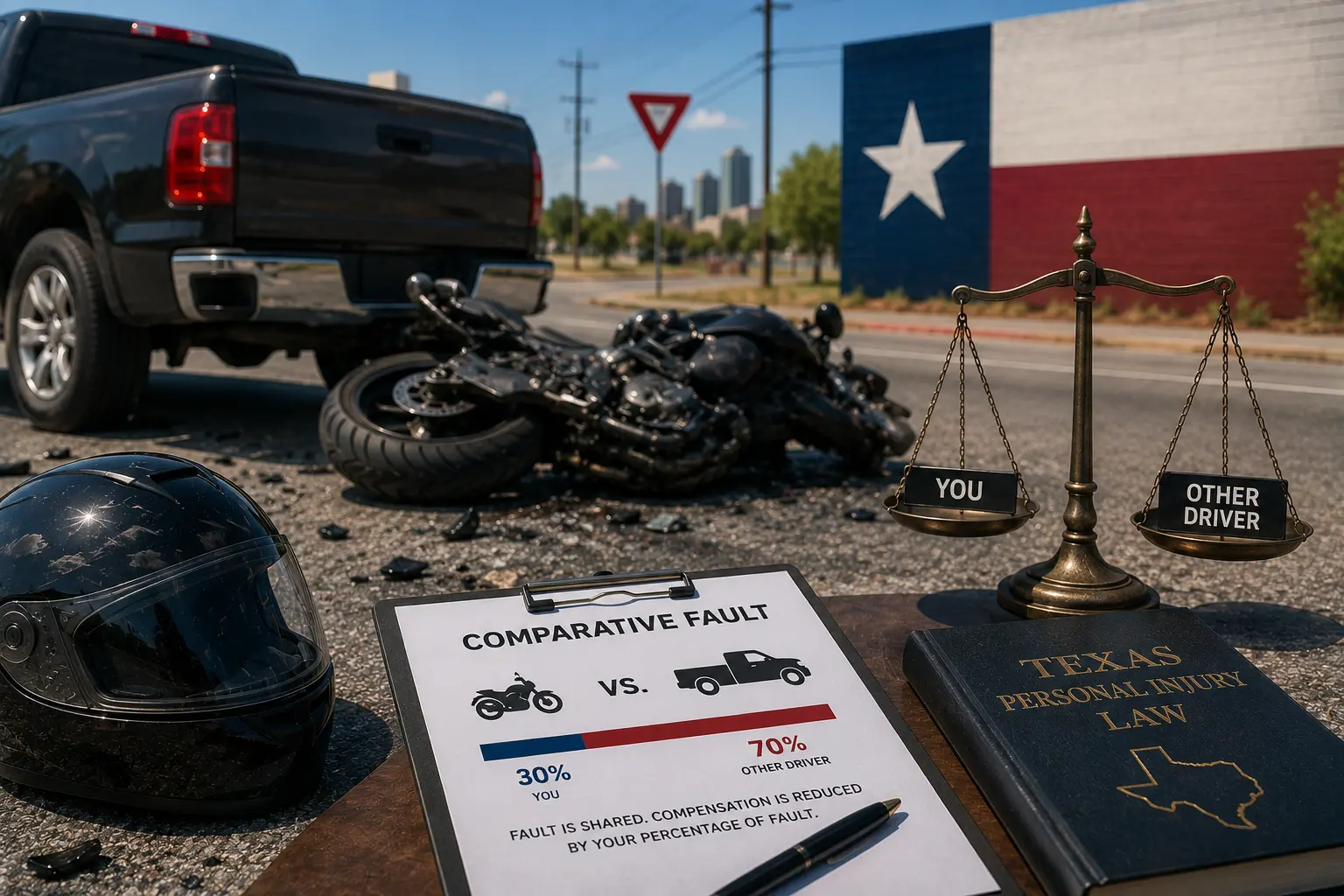
Understanding Texas motorcycle accident comparative fault is the difference between accepting a quick denial and recovering what you are owed. Insurers love to tell injured riders the crash was their fault, hoping they walk away. Often that is simply not true, and the law gives a partly-blamed rider far more room to recover than the adjuster will ever volunteer to tell you.
This guide explains the 51% rule, how the helmet question fits in, and how a partially-at-fault rider still gets paid. The short version: partial fault is not the end of your claim, and your helmet choice is not a free pass for the driver who actually hit you. For the full picture, see our Houston motorcycle accident page.
Texas Modified Comparative Negligence and the 51% Bar
Texas follows modified comparative fault, also called proportionate responsibility, under Texas Civil Practice and Remedies Code Section 33.001. If you are 51% or more at fault, you recover nothing. At 50% or less, you recover, but your award drops by your percentage of fault. The jury, or the adjuster predicting what a jury would do, assigns a percentage to each party. That single number, more than almost anything else, decides what your claim is worth, which is why the fight over it is so important.
Here is the math. If your claim is worth $100,000 and you are found 30% at fault, you recover $70,000. If your share rises to 50%, you collect $50,000. Cross to 51%, and you collect nothing. There is no partial credit above that line. A rider found 51% at fault on a clear, serious injury walks away with zero, which is why the difference between 49% and 51% is the difference between a real recovery and nothing. Every percentage point matters, and the line at 51% is everything. Because the rule is all-or-nothing at that threshold, a fault fight that looks like a minor disagreement can decide whether you recover a six-figure sum or nothing at all. That is why we treat every fault argument as worth contesting. It also means small facts can swing the whole result. Whether the car had its turn signal on, where the impact landed on each vehicle, and what a nearby witness actually saw can move your assigned fault share by the few percentage points that decide the entire case. We chase those details because they are worth real money here.
That is why insurers fight so hard to push a rider’s share of fault upward. A few points of fault, manufactured from a vague claim that you were speeding or hard to see, can quietly cut a large claim down or push it over the line entirely. Inflating your blame from 40% to 51% does more than lower the payout, it eliminates it entirely. Holding the line on fault is often the single most valuable thing that happens in a motorcycle case.
Being blamed for your motorcycle crash? Call (727) 306-3324 or request a free case evaluation.
The Helmet Rule for Riders Over 21
Texas helmet law lives in Texas Transportation Code Section 661.003. Riders and passengers under 21 must wear a helmet. Riders 21 and older may ride without one if they completed an approved motorcycle safety course or carry health insurance covering motorcycle injuries.
An officer cannot even stop you solely to check whether you meet the exemption. So a qualified rider who goes without a helmet is breaking no law, which matters when the insurer tries to use that choice against you.
The key point: whether you wore a helmet has nothing to do with whether another driver caused the crash. Fault is about who caused the collision, and a helmet cannot change that. It can only ever enter the case as a possible reduction to one narrow slice of damages. Think of it like a seatbelt argument in a car case. Many riders assume that being helmetless ends the conversation, so they never call a lawyer and the deadline quietly passes. That assumption costs riders real money every year, because the claim was winnable all along. Going without one does not erase the at-fault driver’s responsibility, and at most it can affect the damages tied to injuries the gear would have prevented. The helmet is a damages footnote in some cases, never a bar to the claim itself.
How the Defense Uses the Helmet Against You
Insurers try to fold the helmet question into comparative fault. The argument goes: even if the driver caused the crash, the rider’s choice to go helmetless made a head injury worse, so the rider should bear part of the responsibility for that injury.
It is a damages argument dressed up as a fault argument, and it has real limits. It can only touch the portion of your damages tied to a head or brain injury. Road rash, broken bones, and spinal injuries stay fully recoverable no matter what was on your head. A helmet protects the head and nothing else, so by simple logic it can only bear on head and brain injuries. We do not let an insurer quietly apply a helmet discount across an entire claim when it could only ever touch one part of it. When a reduction does apply, it is a percentage of the head-injury damages alone, so even in a worst case the effect is usually modest rather than fatal to the claim.
For a rider who met the exemption, the argument is weaker still, because the defense cannot point to any violation of the law. Doing something the law expressly permits is not negligence, and we make the insurer answer for stretching it that far. The argument also looks different for a rider under 21, who is required to wear a helmet. There a violation exists, and the comparative-fault argument has more footing on the head-injury portion. Who you are and what the law required of you shape how much weight, if any, the helmet carries. Insurers rarely explain this nuance. They simply note that you were helmetless and float a large across-the-board reduction, hoping you do not know the limits. We hold them to the rule: show the head-injury portion, prove a helmet would have changed it, and leave the rest of the claim alone.
Insurer blaming your helmet choice? Call (727) 306-3324 or request a free case evaluation.
When No Helmet Does and Does Not Affect Your Claim
Cut through the noise and the helmet question is narrower than insurers pretend:
- No head injury: the helmet is irrelevant to your claim
- You wore a helmet: it never comes up
- Head injury, but you were exempt and rode legally: the defense must still prove a helmet would have helped
- Non-head injuries like fractures and road rash: fully recoverable regardless
Even where it applies, the defense has to prove that a helmet would have prevented or reduced your specific head injury, which takes medical and engineering evidence. A violent enough impact injures the brain regardless of headgear, and we bring our own experts to make that point. A treating physician and, where needed, a biomechanical specialist can explain why a helmet would not have prevented the injury you actually suffered. Once the defense has to prove causation against real medical testimony, the argument usually shrinks or collapses. In many cases the reduction, if any survives, is a modest percentage of only the head-injury damages, not the whole claim. A rider with a broken leg, a shoulder injury, and a concussion still recovers fully for the leg and shoulder no matter what the helmet argument does to the concussion piece.
Proving the Other Driver Caused the Crash
Because fault decides everything under the 51% rule, the case is won with evidence, not assumptions. We move quickly to lock down the proof before it disappears:
- The police report and the officer’s observations
- Scene photos, skid marks, and vehicle damage angles
- Traffic-camera and any dashcam footage
- Witness statements
- The other driver’s own words at the scene
Most motorcycle crashes are caused by drivers who did not see or did not respect the rider, through left turns, unsafe lane changes, and failures to yield. The physical evidence usually shows the car turned or merged into the rider, not the other way around. The steps you take after the crash help preserve that proof.
Telling the rider’s story as a person, not a stereotype, matters too. A rider commuting to work, riding within the law, and hit by a distracted driver is a sympathetic plaintiff once the facts are clear, which our Houston car accident team keeps front and center.
Need the evidence preserved fast? Call (727) 306-3324 or request a free case evaluation.
Damages a Partially-At-Fault Rider Can Recover
As long as you stay at or below 50% fault, you can recover the full range of damages, reduced only by your share:
- Past and future medical bills
- Lost wages and reduced earning capacity
- Pain, suffering, and mental anguish
- Property damage to your motorcycle, including the gear damaged in the crash
Because Texas has no mandatory no-fault coverage, your recovery comes from the at-fault driver and, where they fall short, your own uninsured and underinsured motorist coverage. Reducing your share of fault and finding every policy are the two levers that drive value. With no automatic no-fault coverage in Texas, a rider facing serious bills feels financial pressure fast, and insurers count on that to push a quick, low settlement. We take that pressure off by moving the case forward so you settle on the strength of the facts, rather than out of financial fear and mounting bills. Where it helps, we line up treatment so your care continues while the case develops, so a financial squeeze never forces you into a quick, low number on a serious injury. Our Texas personal injury page explains how those pieces fit together.
The Texas 2-Year Deadline
Texas generally gives you two years from the crash to file a lawsuit under Texas Civil Practice and Remedies Code Section 16.003. Miss it and the claim is gone, no matter how clearly the other driver was at fault.
The practical deadline is shorter, because the evidence that defeats a comparative-fault argument fades fast. Footage gets overwritten, skid marks wash away, and witnesses move on within weeks.
Acting early does double duty for a rider: it preserves the legal deadline and it locks in the proof that keeps your share of fault low. Both protect the value of the claim. An investigator on the scene early, before footage is overwritten and skid marks fade, often locks in the very proof that keeps your fault share low. That early work is some of the most valuable in the entire case. We also document the rider’s own conduct to head off the bias before it starts, capturing gear, lane position, and speed from the available evidence: a valid license and endorsement, lawful speed, and proper lane position all undercut the reckless-biker stereotype the defense leans on. The cleaner that picture, the lower your fault share stays. The same evidence that lowers your fault also raises your credibility, and a credible, sympathetic rider is worth more to a jury than the stereotype the defense is selling. Building that credibility is steady work across the whole case, from the first medical visit to the final demand, and it pays off directly in the value of the claim. Riders who try to handle this alone often surrender fault points they never owed, simply because they did not know how to push back. That is the gap we close. From the first call, we treat the fault fight as the high-stakes contest it is under the 51% rule, because here a few points of blame can be worth a great deal of money.
How United Law Group Can Help
We fight the fault fight with evidence, keep the helmet argument in its narrow lane, find every policy that can pay, and value the full claim. When the insurer will not pay fair value, we file suit. Riders should not have to fight that bias alone. Owner Jack Vasilaros reviews these cases personally.
We work on contingency, so there is no upfront cost and no fee unless we win. The consultation is always free. Jack’s got your back from the first call to the final check.
Can I recover if I was partly at fault for a Texas motorcycle crash?
Yes, as long as you are 50% or less at fault. Under Texas modified comparative fault, your award drops by your share, and only at 51% or more are you barred from recovering.
Does not wearing a helmet bar my claim in Texas?
No. Going without a helmet does not bar a claim. If you were over 21 and met the safety-course or health-insurance exemption, you broke no law, and the helmet at most affects head-injury damages.
How does the helmet defense actually work?
The insurer argues a helmet would have reduced a head injury, so the head-injury damages should drop. It does not touch other injuries, and the defense must prove a helmet would have changed your specific outcome.
How much can the insurer reduce my claim?
Only by your share of fault, and the helmet argument only by the portion tied to a head injury. We push back on inflated fault percentages because every point comes off your recovery.
What if the insurer says the crash was my fault?
That is their opening position, not the final word. Evidence like the police report, footage, and vehicle damage often shows the other driver caused the crash, which protects your recovery.
How long do I have to file in Texas?
Two years from the crash under Section 16.003. Acting early also preserves the evidence that keeps your share of fault low.
What does a motorcycle accident lawyer cost?
Nothing upfront. We work on contingency, so you pay no fee unless we win, and the consultation is free.