
Who Is Liable in a Texas Truck Accident?
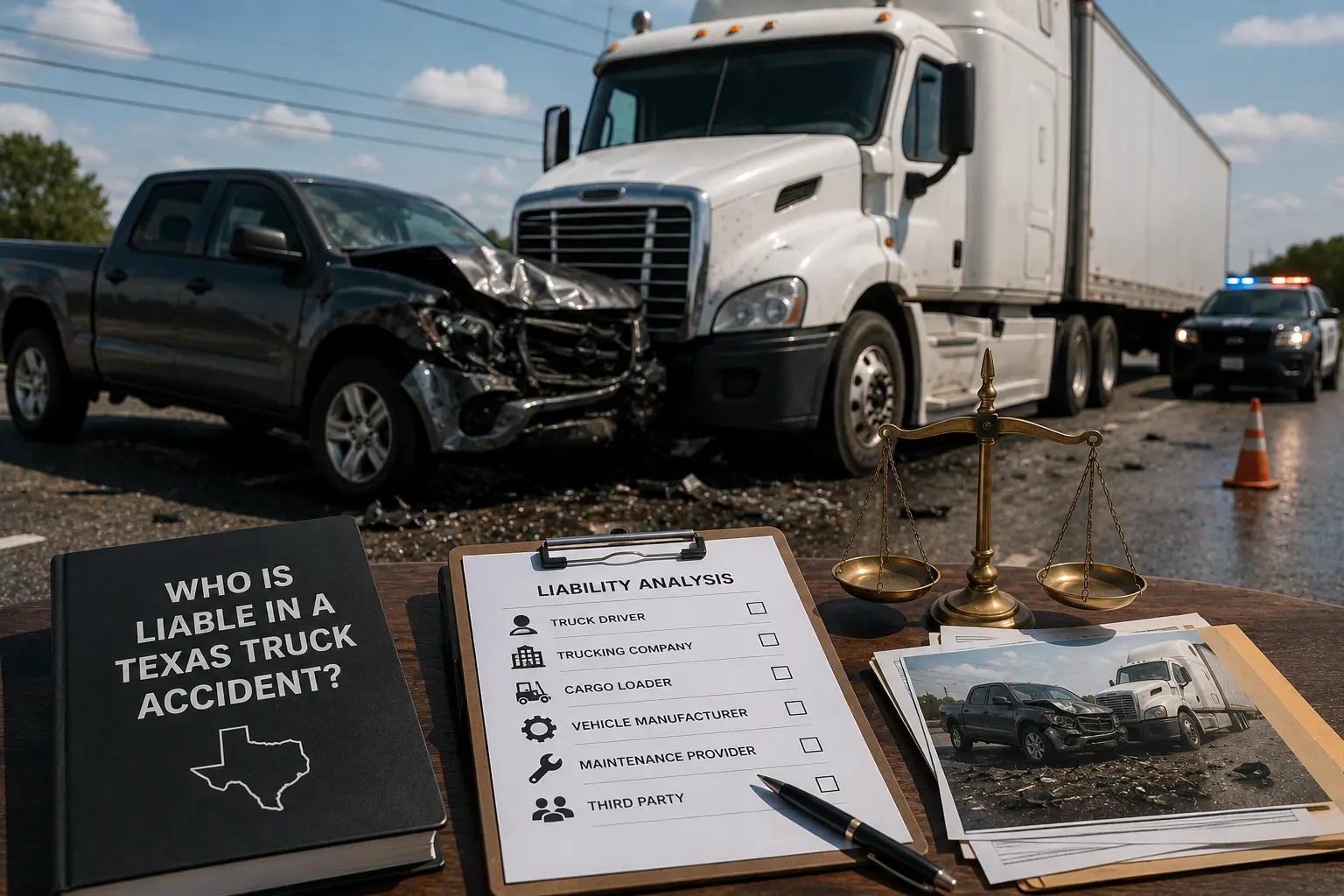
The question of who is liable in a Texas truck accident rarely has a simple answer, and that complexity works in your favor. Where a car crash usually means one driver and one policy, a truck crash can pull in a chain of companies, each with its own coverage, and reaching all of them is what turns a capped claim into a full recovery. Knowing where to look, and which records expose each company, is half the battle, and it is exactly the work an experienced trucking lawyer does from the first day on a serious case.
This guide walks through every party that can be on the hook and why finding them all matters. The short answer is that more responsible parties usually means more available insurance, which is often what makes a full recovery possible. For how these claims are built, see our Houston 18-wheeler accident page.
The Truck Driver: Negligence and Hours-of-Service Violations
The driver is the most obvious place liability starts. Speeding, distraction, impairment, and fatigue all cause truck crashes, and fatigue is governed by federal rules. The Federal Motor Carrier Safety Administration caps driving at 11 hours after 10 hours off duty, bars driving past the 14th hour on duty, and requires a 30-minute break after 8 hours.
When a driver breaks these rules, the violation itself helps prove negligence. A logbook showing 14 straight hours behind the wheel is powerful evidence that fatigue caused the crash, and the truck’s electronic logging device records the hours in a way paper logs never could.
But the driver is rarely the deepest pocket, and an individual driver’s personal exposure is often limited. That is exactly why the analysis cannot stop with the person behind the wheel. The driver is also frequently an employee or contractor of a much larger company, and Texas law lets you reach that company in several ways. Stopping at the driver would leave most of the available insurance, and most of the responsibility, on the table. It is common for the company to admit the driver was its employee, hoping that ends the inquiry into its own conduct. We do not let it, because the carrier’s hiring, training, and scheduling decisions are often where the real negligence lies and where the larger exposure sits.
Hurt in a Texas truck crash? Call (727) 306-3324 or request a free case evaluation.
The Trucking Company: Respondeat Superior and Negligent Hiring
The trucking company is usually the central defendant, and Texas law reaches it in more than one way. Under respondeat superior, an employer is generally responsible for the negligence of an employee acting within the scope of the job, so a company is on the hook for its driver’s on-the-job crash.
The company can also be directly negligent. That distinction matters, because direct claims target the carrier’s own decisions rather than borrowing the driver’s negligence. Negligent hiring, negligent retention, negligent training, and negligent supervision all apply when a carrier puts an unqualified or dangerous driver on the road, or ignores a known problem. Negligent entrustment covers handing a truck to a driver the company should not have trusted. Each of these theories opens a different part of the company’s conduct to scrutiny, and a single crash can support several at once. The more of them the facts support, the harder it is for the carrier to wall off its own responsibility behind the driver.
These theories matter because they reach the company’s larger insurance and its own conduct, well beyond the driver’s mistake. A carrier that skipped a background check, ignored a failed drug test, or pushed an illegal schedule has exposure well beyond a single bad driver. These direct-negligence theories also let us put the company’s own conduct in front of a jury, not only the driver’s split-second mistake. A pattern of cutting corners on safety is far more damaging to a carrier than one driver having a bad day. Texas does limit some direct-negligence claims once a company concedes responsibility for its driver, so the strategy has to be built carefully. We preserve every viable theory early rather than let the carrier narrow the case to a single, easier-to-defend issue.
Brokers and Shippers
Freight brokers arrange the load between the shipper and the carrier, and they can be liable when they hire an unsafe carrier. A broker that ignores a carrier’s poor safety record, expired insurance, or history of crashes may share responsibility for putting that carrier on the road.
Shippers can be liable too, particularly when they load the cargo or control how it is secured. Broker and shipper liability is a developing and fact-specific area, often turning on how much control each had over the trip and the load. Federal safety ratings and a carrier’s crash history are public, so a broker that hired a carrier with obvious red flags has a hard time claiming ignorance. We pull those records to test whether the broker should have known better. The same logic reaches shippers who controlled loading and any leasing company in the chain of ownership. Each relationship is a potential source of duty and coverage, and the carrier rarely volunteers the ones that point away from it. Untangling who controlled what takes the contracts, the dispatch records, and the insurance certificates, which is why these cases reward an early, thorough investigation rather than a quick demand to the first insurer that answers the phone.
Pursuing brokers and shippers takes investigation, because these relationships are layered and the companies prefer to stay out of the case. We follow the contracts and the records to every party that owes a duty. Our guide on hidden commercial insurance policies shows where the extra coverage often hides.
Not sure who is responsible for your crash? Call (727) 306-3324 or request a free case evaluation.
Maintenance Companies and Parts Manufacturers
A truck is only as safe as its brakes, tires, and steering, and those systems are often serviced by third parties. When a maintenance company performs a shoddy repair or skips a required inspection, and a failure causes the crash, that company can be liable.
Parts manufacturers enter the picture when a defective component, a failed brake part, a blown tire, or a faulty coupling, causes or worsens the wreck. These product-liability claims add another defendant and another layer of insurance. Manufacturers and their insurers are sophisticated and well-funded, so these claims require real proof, often an expert teardown of the failed part. Done right, they can add substantial coverage to a case that would otherwise be capped by the trucking policies alone.
Pinning down a mechanical cause takes fast evidence work, because the truck and its parts can be repaired, sold, or scrapped before anyone inspects them. Preserving the vehicle is often essential to proving this kind of liability. That is one more reason a fast investigation matters: once the truck is repaired or returned to service, the physical proof of a brake or tire failure may be gone for good, and with it a potential defendant and another layer of coverage.
Cargo Loaders
How a truck is loaded affects how it handles, and a poorly loaded or overweight trailer can cause a rollover, a jackknife, or a load spill. When a separate company loads or secures the cargo, that company can share liability for a crash the bad load caused.
Overloading and improper securement violate federal rules, so these failures often double as negligence per se, the same way an hours-of-service violation does. Negligence per se is a powerful shortcut: instead of arguing about what a reasonable company would have done, we point to the specific federal rule the defendant broke. A clear violation tied to the crash makes the liability case far harder to dispute. It also shifts the conversation from a debate about reasonableness to a simple question of whether the rule was followed, which is a much stronger position for an injured person. The shipping documents and weight records help prove what went wrong.
Each added party is also another source of records that can prove the crash. The cargo loader’s paperwork, the maintenance logs, and the broker’s carrier-selection file all build the picture of what happened and who is responsible. Bills of lading, weight tickets, and loading diagrams can show a trailer was overloaded or unbalanced, which explains a rollover or jackknife and points straight at the company that loaded it. These documents also help reconstruct the trip, the schedule, and the pressure the driver was under, which can tie the crash back to the carrier’s own demands and dispatch decisions rather than a single momentary lapse behind the wheel.
How Layering Defendants Raises Recovery
Identifying every liable party is not about spreading blame for its own sake. It is about reaching enough total coverage to actually pay for the full, long-term cost of a catastrophic injury. A single driver’s personal policy alone may fall far short of what a serious, life-changing truck crash actually costs. The federal minimums for carriers are far higher than a personal auto policy, and stacking additional defendants on top can push the available coverage well into the millions where the injuries justify it.
Add the carrier, the broker, a maintenance company, and a parts maker, and the available insurance can climb well past any single policy. Federal law already requires most carriers to hold large policies, and stacking responsible parties on top expands the recovery further. Our Texas 18-wheeler settlement guide shows how that translates into value.
Texas comparative fault runs through all of it. Liability gets apportioned among the responsible parties, and as long as you are 50% or less at fault, you recover from those who share the blame. Spreading the fault across several at-fault companies can also work in your favor, because it keeps your own share low and opens more policies to contribute to the result. Mapping the full set of defendants is how a serious claim reaches its real value. A catastrophic injury against a single driver’s policy stalls at that limit, but the same injury against a carrier, a broker, a maintenance company, and a parts maker can reach the full measure of the loss. The investigation into who is responsible is, in practice, an investigation into how much you can recover. That is why we resist the temptation to settle quickly with the first, most obvious defendant. Releasing one party too soon can complicate claims against the others, so we map the whole field before resolving any single piece of it. Coordinating the timing and the releases is part of getting the full value, and it is easy to get wrong without experience in multi-defendant trucking cases. We handle that sequencing deliberately, so settling with one party never quietly forecloses a larger recovery from another.
Want every liable party identified? Call (727) 306-3324 or request a free case evaluation.
The Texas 2-Year Deadline
Texas generally gives you two years from the crash to file suit under Texas Civil Practice and Remedies Code Section 16.003. With a truck case the practical clock is shorter, because the records and physical evidence that identify each defendant can disappear long before two years pass.
Electronic logs can be overwritten in weeks, trucks get repaired or sold, and carrier files get archived. Each lost piece can mean a lost defendant, and a lost defendant can mean lost coverage.
Acting early is therefore about more than the deadline. The sooner the investigation starts, the more parties can be identified and held responsible, which directly affects what you can recover.
Our Houston personal injury team starts that work the day you call, while the records still exist and the trail is fresh.
How United Law Group Can Help
We send preservation letters the day you call, pull the federal and company records, and identify every party that shares the blame, from the driver to the broker to the parts maker. The more defendants we can hold responsible, the more coverage there is to pay your claim. Owner Jack Vasilaros reviews these cases personally.
We work on contingency, so there is no upfront cost and no fee unless we win. We advance the costs of building the case, and the consultation is free. Jack’s got your back from the first call to the final check.
Who can be liable in a Texas truck accident?
Often more than one party: the driver, the trucking company, a freight broker, a shipper, a maintenance provider, a cargo loader, and a parts manufacturer. Each can carry insurance, which raises what you can recover.
Can I sue the trucking company as well as the driver?
Yes. Under respondeat superior the company is responsible for its driver’s on-the-job negligence, and it can be directly liable for negligent hiring, training, or supervision. The company usually carries the larger insurance. For a catastrophic injury, that distinction is everything, because a driver’s policy alone rarely comes close to covering a lifetime of medical care and lost earnings. That is the practical reason these cases focus so heavily on reaching the company and the other businesses behind the trip. A driver alone rarely has the assets or the insurance to make a catastrophically injured person whole, so finding the companies that share responsibility is not a technicality at all. It is the heart of the recovery, and often the difference between a token payout and a result that covers a lifetime of care. We pursue every one of them so the size of your recovery is set by your losses, not by the thin coverage of a single driver. That is also why we resist a fast handshake with the first insurer to call: a quick release can quietly shut the door on the larger recoveries still in play, and once a release is signed, it cannot be undone.
Can a freight broker be liable?
Sometimes. A broker that hires a carrier with a known unsafe record, expired insurance, or a history of crashes can share liability. It is a fact-specific area that turns on how much control the broker had.
Why does it matter how many parties are liable?
Each liable party can carry its own coverage. Layering defendants expands the available insurance, which is often what makes a full recovery possible after a catastrophic truck crash.
How long do I have to file in Texas?
Two years from the crash under Section 16.003. With truck cases, the evidence that identifies each defendant can vanish much sooner, so acting quickly is critical.
What if I was partly at fault?
You can still recover as long as you are 50% or less at fault. Texas apportions liability among the responsible parties, and your award drops by your share.
What does a truck accident lawyer cost?
Nothing upfront. We work on contingency, advance the case costs, and collect a fee only if we win. The consultation is free.