
Average Motorcycle Accident Settlement in Florida
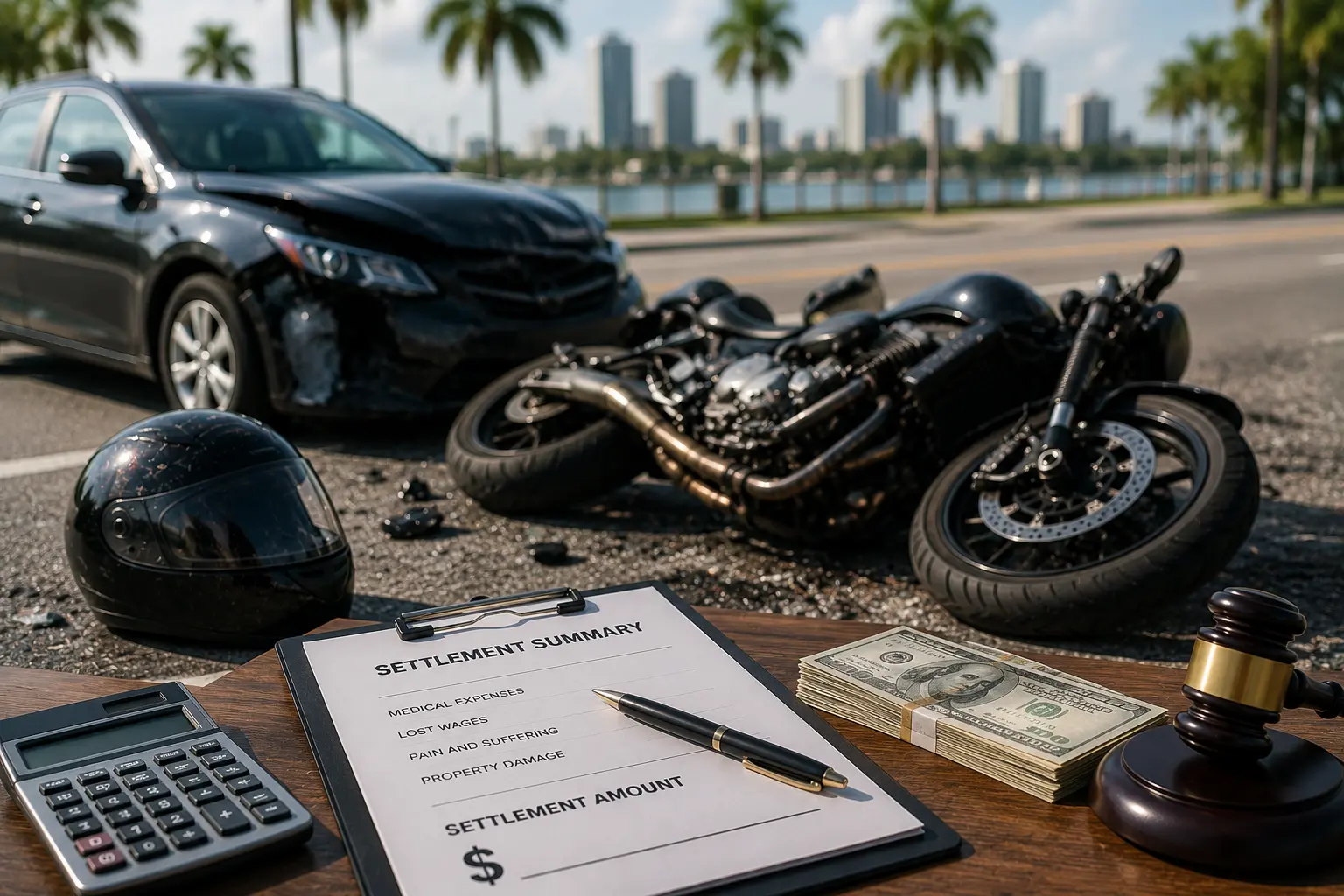
If you are searching for the average motorcycle accident settlement Florida riders receive, you want a number, and the honest answer is that the range is enormous. What matters is understanding the factors that move your case within that range.
Below we break down realistic ranges by injury type, what raises and lowers a payout, and the no-PIP gap that makes coverage the deciding factor for riders. For the legal side, see our Florida motorcycle accident lawyers page.
Why ‘Average’ Misleads for Motorcycle Cases
The word average does more harm than good here. A few catastrophic cases that settle in the millions pull the statistical average far above what a typical claim pays, while most cases cluster much lower. An average tells you almost nothing about your specific case.
Motorcycle claims also skew more severe than car claims, because riders have little protection in a crash. The same impact that dents a car can break a rider’s bones or worse, so the injury, and therefore the value, runs higher and varies more widely than a typical auto claim.
Be careful with the word average for another reason: a median, the middle case, tells you far more than an average that a few huge verdicts distort. And neither one knows your facts. Two riders hit at the same intersection can land thousands of dollars apart based on injury, fault, and coverage alone.
Online settlement calculators make this worse. They take a generic formula, plug in your bills, and spit out a number that ignores fault, policy limits, and the no-PIP gap that defines rider cases in Florida. A calculator cannot tell you what your claim is worth, and trusting one often leads riders to accept too little.
The useful question is not what the average is. It is what drives value up or down, and where your specific case lands on that scale once the facts are known. That is what we walk through next.
Want a real read on your case value? Call (727) 306-3324 or request a free case evaluation.
Settlement Ranges by Injury Type
Every case turns on its own facts, so treat these as general guides, not promises. Based on how Florida motorcycle claims commonly resolve:
- Minor injuries, road rash or soft tissue: roughly $3,000 to $25,000
- Moderate injuries, broken bones or a herniated disc: roughly $25,000 to $100,000
- Serious injuries needing surgery or long recovery: often $50,000 to $200,000
- Catastrophic injuries, brain, spinal, or amputation: six to seven figures, sometimes over $1 million
Notice how fast the numbers climb with severity. A rider who walks away with road rash and one who suffers a spinal injury are not in the same universe of value, which is why a one-size number is meaningless.
It helps to see how the pieces add up. A moderate case might combine $30,000 in medical bills, several weeks of lost wages, and a pain-and-suffering figure that reflects months of recovery, landing in the moderate range. A catastrophic case adds lifelong care, lost earning capacity, and far larger non-economic damages, which is why it climbs into six and seven figures.
These ranges also assume there is coverage to pay them. A catastrophic injury is only worth its full value if enough insurance exists to reach, which brings us to the factors that actually control the outcome.
It is also worth saying plainly: no honest lawyer can promise a number from a website. Anyone who guarantees a specific settlement before reviewing your medical records, the police report, and the available policies is selling something. A real estimate comes after the facts are in, not before.
What Raises and Lowers a Rider’s Payout
Several factors push the number up or down, and most of them can be influenced by how the case is built:
- Injury severity and whether the harm is permanent
- Total medical bills, including future care
- Lost wages and reduced earning capacity
- How clearly the other driver was at fault
- The at-fault driver’s policy limits and your own UM coverage
Documentation is what turns these factors into dollars. A permanent-impairment rating, a clear fault picture, and a well-supported lost-income claim all raise value, while treatment gaps and thin records hand the insurer reasons to pay less.
Some factors cut against you, and they are worth knowing. A delay in treatment, a prior injury to the same body part, a partial fault argument, and a low policy limit all drag the number down. None of these are automatically fatal, but each one is a lever the insurer pulls, and a prepared case answers them before they become discounts.
The quality of your legal representation belongs on the list too. Studies of injury claims have long shown that represented claimants tend to recover more on average, even after fees, because lawyers value the claim correctly, find the coverage, and refuse the first offer. On a rider case, where the no-PIP gap and the bias both work against you, that difference tends to be larger, not smaller.
Future losses matter as much as past bills. A spinal or brain injury can mean years of care and a permanent hit to earning power, and a settlement signed today has to account for all of it, because you cannot reopen the claim later. We build the medical and economic picture forward, well past the date of the check.
Lost income is a piece riders often undervalue. A serious injury can keep a worker off the job for months, and that loss is recoverable alongside the medical bills. Our guide on how Florida values injury claims covers the damage categories in detail.
The No-PIP Gap and How UM Coverage Changes the Math
Here is the factor unique to riders. Under Florida Statute 627.736, no-fault PIP covers motor vehicles, and Florida does not treat motorcycles as motor vehicles. So your auto PIP does not pay for motorcycle crash injuries, and there is no automatic first-party medical coverage to lean on.
That makes the at-fault driver’s liability policy and your own uninsured or underinsured motorist coverage the real sources of recovery. When the at-fault driver carries little or no insurance, your UM coverage often becomes the ceiling on what you can collect, no matter how serious the injury.
Florida also has a high share of uninsured and underinsured drivers, which makes this gap a live risk rather than a rare one. A rider can have a clear, serious case and still be capped at a small policy limit if there is no UM coverage to reach past it. That single fact decides more rider outcomes than almost anything else.
This is the single most important thing a rider can do before ever crashing: carry strong uninsured and underinsured motorist coverage. It is inexpensive relative to what it protects, and on a motorcycle, where there is no PIP, it is often the difference between a real recovery and almost nothing after a serious crash with an underinsured driver.
It is also why two riders with identical injuries can receive very different settlements: one had strong UM coverage and the other did not. Finding and stacking every available policy is the heart of maximizing a rider’s recovery. Our Florida PIP guide explains how no-fault works and where motorcycles fall outside it.
Not sure how much coverage applies to your crash? Call (727) 306-3324 or request a free case evaluation.
How Fault Affects the Number
Since House Bill 837, Florida uses modified comparative negligence with a 51% bar. If you are more than 50% at fault you recover nothing, and below that your award drops by your share. So a $100,000 case with 20% of the blame on the rider pays $80,000.
Riders face an extra hurdle here, because insurers and juries can carry a bias against motorcyclists. The insurer will try to pin fault on the rider, claiming speeding or weaving, to shrink the payout under the comparative-fault rule.
The practical effect is that fault is worth fighting hard, dollar for dollar, because every point the insurer shifts onto you comes straight off the settlement. A crash that looks like shared blame at first glance often turns out to be almost entirely the driver’s fault once the evidence comes in, and that swing can be worth tens of thousands of dollars.
We counter the bias with evidence and by humanizing the rider, so it has nowhere to land. The helmet question can also surface as a damages argument, which our Florida helmet law and your claim guide addresses in full.
Timeline From Claim to Settlement
Riders want to know how long this takes. The honest answer tracks the injury. Minor claims can resolve in a few months, while serious cases often run a year or more, especially if the insurer forces a lawsuit.
The biggest driver of timing is reaching maximum medical improvement, the point where doctors can say how far you will recover and what limits are permanent. Settling before then means guessing at your future, almost always low, and you cannot reopen the claim after you sign a release.
Faster is not always better. A quick settlement feels like relief when bills are piling up, but for a rider with serious injuries it usually means leaving money behind. The right pace is the one that lets your injuries declare themselves fully while we keep the legal clock protected, so you settle on facts rather than fear.
From there the case moves through a demand, negotiation, and, if needed, a lawsuit that restarts the pressure. We balance patience with the two-year deadline, protecting the clock while the full medical picture develops.
There is a real tension for riders here, because with no PIP, the bills arrive while the case builds. We manage that gap by lining up treatment and, where it helps, using letters of protection so care continues without forcing you into a quick, low settlement just to cover costs. Patience is not passivity, it is how value gets protected.
How We Maximize Rider Recovery
Maximizing a motorcycle settlement comes down to a few disciplined steps: find every policy, build the medical and fault record, document the full economic loss, and prepare the case as if it is going to trial so the insurer takes it seriously.
Because the no-PIP gap makes coverage king, we map your own policies, the at-fault driver’s, and any commercial coverage behind an at-fault work vehicle. A serious injury against a small policy can still reach real money when UM and UIM coverage stacks on top.
We also build the case as if it is going to trial from the start, because that is what moves an insurer off a lowball number. Photos, the crash report, witness accounts, the medical record, and a clear lost-income picture all go into a demand the carrier cannot easily dismiss, and the credible threat of a courtroom does the rest.
The result that matters is the money that actually lands in your pocket, not the headline settlement figure. That is why we negotiate medical liens and outstanding bills down at the end, so a larger share of the recovery stays with you rather than going to providers, and why we are upfront about the contingency fee from the very first call so there are no surprises later.
We also treat the insurer’s first offer as a starting point, never the answer. Early numbers are calculated to close the file before you understand the full scope of your injuries, and on a motorcycle case, where the harm tends to be severe, that gap between the first offer and fair value is often large.
The goal is the net result in your pocket, so we also negotiate medical liens at the end so more of the settlement reaches you. Owner Jack Vasilaros reviews these cases personally, and the consultation is free.
How United Law Group Can Help
We value your claim properly, find the coverage that sets the ceiling, and fight for the full amount rather than the insurer’s first offer. With no PIP backing a rider, that coverage search is often what makes or breaks the recovery.
We work on contingency, so there is no upfront cost and no fee unless we win. The consultation is free, and Jack’s got your back from the first call to the final check.
What is the average motorcycle accident settlement in Florida?
It ranges widely, from a few thousand dollars for minor injuries to over $1 million for catastrophic ones. Because rider injuries skew severe, an average is misleading, and your value depends on severity, bills, lost income, fault, and coverage.
What is a typical payout for a serious motorcycle injury?
Serious injuries that require surgery or long recovery often settle in the range of $50,000 to $200,000, while catastrophic injuries can exceed $500,000 or reach several million, depending on the available coverage.
Why does coverage matter so much for motorcycle claims?
Because Florida PIP does not cover motorcycles, your recovery comes from the at-fault driver’s policy and your own UM coverage. When the at-fault driver is underinsured, your UM coverage often sets the ceiling on the payout.
What lowers a motorcycle settlement?
Treatment gaps, thin documentation, shared fault under the 51% rule, and low policy limits all lower a payout. Insurer bias against riders can also be used to shift fault, which reduces the recovery.
How long does a Florida motorcycle settlement take?
Minor claims can resolve in months, while serious cases often take a year or more. The biggest factor is reaching maximum medical improvement before settling, so the claim reflects your full injuries.
Does going without a helmet lower my settlement?
Only the portion tied to a head injury, and only if the defense proves a helmet would have helped. It does not bar your claim or reduce damages like fractures and road rash.
How much does a motorcycle accident lawyer cost?
Nothing upfront. We work on contingency, so you pay no fee unless we win, and the consultation is free.