
Florida Motorcycle Helmet Law and Your Injury Claim
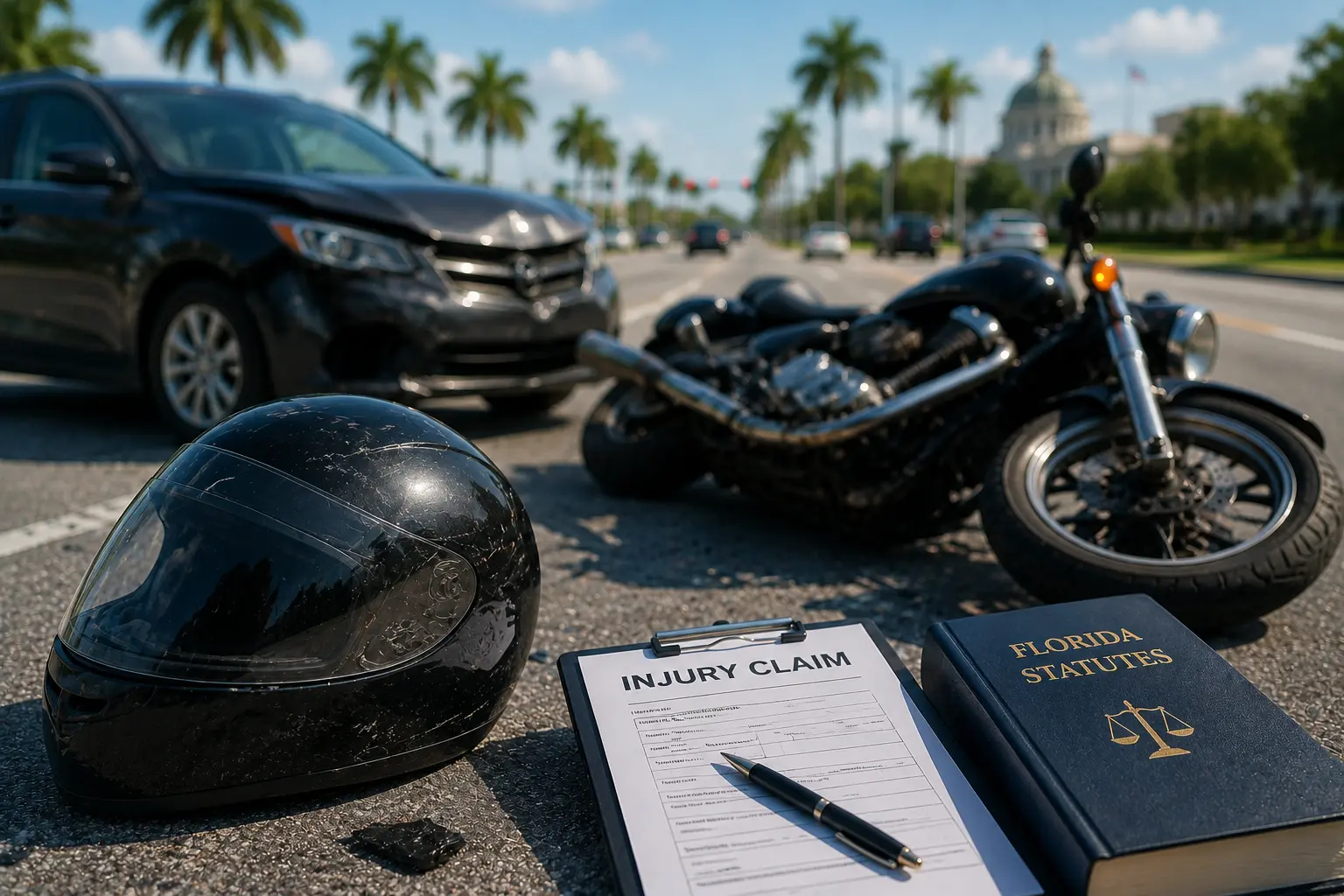
Understanding the Florida motorcycle helmet law injury claim rules can be the difference between accepting a quick lowball and recovering what you are owed. Riders who crashed without a helmet often assume they have no case. That assumption is wrong, and insurers count on it.
This guide explains what Florida’s helmet law really requires, how the defense tries to use it, and what it can and cannot do to your recovery. If you were hurt, start with our Florida motorcycle accident lawyers page, then read on.
Florida’s Helmet Law, Explained
Florida’s rule lives in Florida Statute 316.211. Riders and passengers under 21 must wear a helmet, with no exceptions. Riders 21 and older may legally ride without one, but only if they carry at least $10,000 in medical benefits coverage for motorcycle injuries.
Eye protection is a separate requirement that applies to riders regardless of age, so a rider can be helmet-exempt and still required to wear approved eyewear. These are equipment rules, and they are easy to satisfy, but they are also where insurers go looking for an angle.
The $10,000 medical requirement trips people up, because it has to be coverage specific to motorcycle injuries. Your car’s Personal Injury Protection does not count, since Florida does not treat a motorcycle as a motor vehicle under the no-fault law. Many riders who think they are covered learn otherwise after a crash.
Florida changed to this partial-helmet rule years ago, moving away from a universal requirement, which is why you see so many riders legally helmetless on Florida roads. That legality is exactly the point: if the law lets a qualified rider go without a helmet, an insurer cannot fairly treat that legal choice as the reason to deny a claim caused by someone else.
It is worth confirming your own coverage now, before you ever need it. A rider relying on the exemption who does not actually carry the required $10,000 in motorcycle medical coverage can face both a compliance issue and a thinner safety net, so checking the policy is time well spent before you ride.
Unsure how the helmet rule applies to you? Call (727) 306-3324 or request a free case evaluation.
The Myth: No Helmet Does Not Kill Your Claim
Here is the part that surprises riders. Whether you wore a helmet has nothing to do with whether another driver caused the crash. A driver who turned left across your path is just as liable whether your head was covered or not, and your right to recover for that negligence does not disappear because of your gear.
Florida law does not bar a claim for riding without a helmet. The helmet question can only enter the picture as a possible reduction to a specific slice of damages, and even then only under narrow conditions the defense has to prove.
Compare it to a seatbelt in a car case. Not wearing one does not erase the at-fault driver’s responsibility, it can at most affect the damages tied to injuries the belt would have prevented. The helmet works the same way for riders: it is a damages footnote in some cases, never a bar to the claim itself.
Insurers blur this line on purpose. They imply that going helmetless makes you the responsible party, hoping you accept a fraction of your claim’s value or walk away entirely. Knowing the rule is your best defense against that pressure.
Think of fault and damages as two separate questions. Fault asks who caused the crash, and a helmet has nothing to do with that. Damages ask what your injuries are worth, and a helmet could only ever touch one narrow piece of that second question. Insurers want you to mix the two, because blurring them is how they shrink the number.
How No Helmet Becomes a Comparative-Fault Argument
Since House Bill 837 took effect on March 24, 2023, Florida uses modified comparative negligence with a 51% bar. If you are found more than 50% at fault, you recover nothing, and below that your award drops by your share. The defense tries to fit the helmet question into that framework.
The argument goes like this: even if the driver caused the crash, the rider’s choice to go without a helmet made a head injury worse, so the rider should bear part of the responsibility for that injury. It is a damages argument dressed up as a fault argument.
The key limit is that this can only reduce the portion of your damages tied to a head or brain injury. It cannot touch the rest of your claim, and it cannot bar you under the 51% rule for the simple act of not wearing a helmet. We keep that distinction front and center so the argument stays in its narrow lane.
It also matters that you rode legally. A rider over 21 who carried the required medical coverage was breaking no law by going without a helmet, which makes the comparative-fault argument far weaker than the insurer pretends. Doing something the law expressly permits is not negligence, and we make the defense answer for that overreach.
Contrast that with a rider under 21, who is required to wear a helmet. There, going without one is a violation, and the comparative-fault argument has more footing on the head-injury portion of the claim. The facts of who you are and what the law required of you shape how much weight, if any, the helmet question carries.
Being blamed for going helmetless? Call (727) 306-3324 or request a free case evaluation.
Why It Only Touches Head and Brain Injuries
A helmet protects one thing: your head. So the only damages a missing helmet could logically affect are those flowing from a head or brain injury. Everything else in a motorcycle crash stays fully recoverable.
- Road rash and skin injuries: fully recoverable
- Broken bones, including legs, wrists, and ribs: fully recoverable
- Spinal cord and back injuries: fully recoverable
- Internal injuries and nerve damage: fully recoverable
- Lost wages, future care, and property damage: fully recoverable
So a rider with a shattered leg and no head injury has a claim the helmet question cannot touch at all. Even with a head injury, the rest of the damages stay whole. We make sure insurers do not quietly apply a helmet discount across the entire claim when it could only ever apply to one part of it.
This is also where insurers overreach most often. An adjuster will float a large across-the-board reduction the moment they learn you were helmetless, hoping you do not know the limit. We hold them to the rule: show us the head-injury portion, show us the proof a helmet would have changed it, and leave the rest of the claim alone.
What the Defense Must Actually Prove
The helmet argument is not automatic. To reduce your head-injury damages, the defense has to do real work and prove specific things, well beyond simply pointing out that you were not wearing one.
They generally must show that you were legally required to wear a helmet or that not wearing one was unreasonable, and that a helmet would have prevented or reduced the specific head injury you suffered. That second part takes medical and engineering evidence, because some impacts injure the brain regardless of a helmet.
Causation is the hardest part for them. Brain injuries happen in helmeted riders too, and a violent enough impact injures the brain regardless of headgear. If the defense cannot show that a helmet would have changed your specific outcome, the argument fails and your head-injury damages stay whole.
We meet that with our own experts. A treating physician and, where needed, a biomechanical specialist can explain why a helmet would not have prevented the injury you actually suffered, given the forces involved. Once the defense has to prove causation against real medical testimony rather than wave at a missing helmet, the argument usually shrinks or collapses.
That burden is higher than insurers pretend. We push them to actually prove causation rather than assume it, and we counter with our own medical evidence. For how head-injury damages factor into overall value, see our guide to how Florida values injury claims.
The Real Impact on Settlement Value
In practice, the helmet issue affects far fewer claims than insurers suggest, and when it does apply, the impact is usually a modest reduction to the head-injury portion, not a wipeout of the claim.
If you had no head injury, the helmet question is irrelevant. If you wore a helmet, it never comes up. And if you were over 21 with the required coverage and rode legally without one, the defense still has to prove the helmet would have changed the outcome before it reduces anything.
When a reduction does apply, it is a percentage of the head-injury damages, not the whole claim. So a rider with a $200,000 case where a quarter of the value is head-injury related, and where the defense actually proves a helmet would have cut that harm in half, is looking at a modest reduction, not a lost case. In most files the number barely moves, if at all.
The bigger driver of value is almost always the severity of your injuries and the coverage available, which our companion guide on average Florida motorcycle settlements breaks down. The helmet is a side issue insurers inflate.
Worried a helmet question is shrinking your offer? Call (727) 306-3324 or request a free case evaluation.
Remember: PIP Does Not Cover Motorcycles
This is the rule that matters even more than the helmet question. Under Florida Statute 627.736, no-fault PIP covers motor vehicles, and Florida does not classify a motorcycle as one. So your auto PIP does not pay for your motorcycle crash injuries.
That means your recovery comes from the at-fault driver’s liability insurance and from your own uninsured or underinsured motorist coverage. The $10,000 in medical coverage that lets you ride helmetless is a separate, smaller pool, and it disappears fast after a serious crash.
So the helmet question, real or not, is usually a smaller issue than where the money will actually come from. A rider with strong uninsured-motorist coverage is in a far better position than one without it, no matter what was on their head. The coverage picture drives the recovery more than the gear ever will.
Because of this gap, finding every available policy is the single most important part of a rider’s case. Our Largo motorcycle accident page explains how we track down coverage for injured riders.
What To Do If You Were Not Wearing One
Do not assume you have no claim. That single assumption costs riders real money every year, because they never call a lawyer and the deadline quietly passes before they ever learn what their case was worth. A free consultation costs nothing and tells you exactly where you stand.
- Get medical care and document every injury, head injury or not
- Keep the crash report, your photos of the scene, and all of your damaged gear
- Do not tell the insurer the crash was your fault for going helmetless, because it was not
- Note whether you were 21 or older and what medical coverage you actually carried
- Call a lawyer before accepting any offer or signing a release
Screening early protects you. A short call tells us whether another driver was at fault, what coverage exists, and whether the helmet question even applies to your injuries. You walk away knowing where you stand before spending a dollar, and if there is no claim worth pursuing, we will tell you plainly.
The helmet question is something we handle, not something that should stop you from pursuing what you are owed. Owner Jack Vasilaros reviews these cases personally, and the call is always free with no obligation.
How United Law Group Can Help
We confirm what the law actually allows, keep the helmet argument in its narrow lane, find every policy that can pay, and value the full claim, the parts a helmet could never affect included. When the insurer will not pay fair value, we are ready to file suit.
We work on contingency, so there is no upfront cost and no fee unless we win. The consultation is free, and Jack’s got your back from the first call to the final check.
Can I sue if I was not wearing a helmet in Florida?
Yes. Florida does not bar a claim for riding without a helmet. If another driver caused the crash, you can still recover, and the helmet question at most affects head-injury damages, and only if the defense proves a helmet would have helped.
Do I have to wear a helmet in Florida?
Riders under 21 must always wear one. Riders 21 and older may ride without a helmet if they carry at least $10,000 in medical coverage for motorcycle injuries under Florida Statute 316.211.
Does not wearing a helmet reduce my settlement?
Only possibly, and only the portion tied to a head or brain injury, and only if the defense proves a helmet would have prevented or reduced that specific injury. Road rash, fractures, and other damages stay fully recoverable.
Does my car insurance PIP cover a motorcycle crash?
No. Florida does not classify motorcycles as motor vehicles for no-fault, so auto PIP does not apply. The $10,000 medical coverage for the helmet exemption is a separate, smaller pool.
What does the defense have to prove about my helmet?
Generally that you were required to wear one or it was unreasonable not to, and that a helmet would have prevented or reduced your specific head injury. That takes medical and engineering proof, well beyond the fact you went without.
How long do I have to file a motorcycle claim in Florida?
Two years from the crash for incidents on or after March 24, 2023. Acting early protects the evidence that proves the other driver’s fault.
What if I cannot afford a lawyer?
We work on contingency, so there is no upfront cost and no fee unless we win. The consultation is free, so there is no downside to finding out whether you have a claim.