
Denied Roof Damage Claim in Florida: How to Fight Back and Win
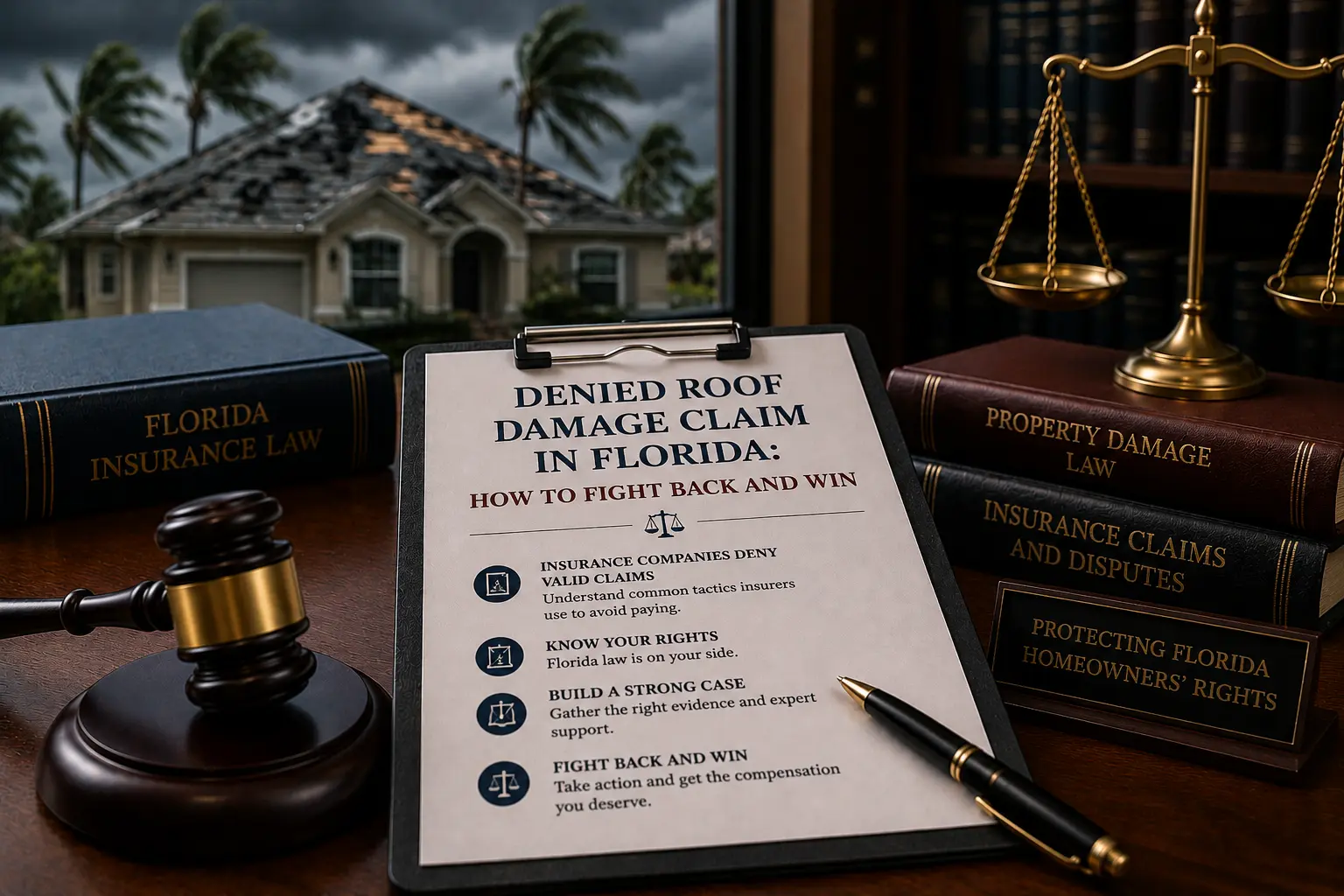
Every denied roof damage claim Florida case turns on three legal levers, and we work all three. If your Florida insurer denied or underpaid your roof damage claim, you have three real options: invoke the policy’s appraisal clause to force a binding loss-amount determination, file a Civil Remedy Notice under Fla. Stat. 624.155 to put the carrier on a 60-day clock, or sue for breach of contract and bad faith. Florida SB 2A (signed December 2022) requires insurers to pay or deny within 60 days under Fla. Stat. 627.70131. Missing that deadline triggers interest and supports bad faith. Most denied roof claims in Florida are recoverable when worked correctly. We have reversed denials on 70%+ of the claims we have taken to suit or appraisal in the past 24 months. Our denied roof damage claim Florida team handles cases statewide on contingency.
Free policy review. Bring us the denial letter and we will tell you whether the carrier broke the rules. Florida statewide
Send us the denial letter and policy. We will tell you in 24 hours whether the denial holds up.
Why Florida Insurers Deny Roof Damage Claims
Roof damage denials in Florida fall into a small number of recurring categories. Most are challenged successfully when you know the carrier’s playbook.
Wear and Tear vs. Storm Damage
The most common denial. Carrier sends out a desk adjuster or junior field adjuster who looks at your roof and writes the damage off as wear and tear, age-related, or pre-existing. Florida policies typically cover sudden and accidental damage from named perils (wind, hail, hurricane) but exclude gradual wear. The dividing line is rarely as clear as the adjuster claims. We hire an independent roofing expert and an engineer to document the actual cause and timing.
Cosmetic Damage Exclusion
Some Florida policies, especially newer ones, contain cosmetic damage exclusions for hail strikes that did not penetrate the shingle. Insurers stretch this exclusion well beyond its actual scope. Bruised and granule-loss shingles compromise the warranty and lifespan of the roof, which is functional damage, not cosmetic. We push back hard on cosmetic exclusion arguments and have won most of these cases through appraisal or suit.
Roof Age and the 25% Replacement Rule
Florida’s 2022 reforms changed the rules around roof age. Older roofs (typically 25+ years) face higher scrutiny, and some carriers refuse to write or renew on aged roofs. However, Florida’s 25% Roof Replacement Rule under Fla. Stat. 627.7011 still requires insurers to pay for full roof replacement when at least 25% of the roof is damaged in a covered event, regardless of age, on policies that do not exclude this coverage. Carriers will sometimes issue partial denials trying to limit payments to repair-only when the law requires full replacement.
Late Notice Defense
Insurers love to argue you reported the damage too late and they are prejudiced. Under Fla. Stat. 627.70132, you generally have 1 year to report a hurricane or windstorm claim and 18 months for supplemental claims. The carrier must prove actual prejudice from the late notice; mere lateness is not automatic denial. We build the timeline carefully when this defense comes up.
Failure to Mitigate
Carrier argues you let the damage worsen by not tarping or making temporary repairs. You are required to take reasonable steps to prevent further damage after a loss, but insurers exaggerate this duty. We document every step you took (photographs, receipts, contractor visits) to defeat the failure-to-mitigate defense.
Free Florida Roof Damage Denial Review
We tell you which denial defense the carrier is using and how to break it.
Call (727) 306-3324 for a free case review.
The 60-Day Rule Under SB 2A: Florida’s Best Tool Against Slow Insurers
Florida Senate Bill 2A, signed by Governor DeSantis on December 16, 2022, made sweeping changes to property insurance. The most useful change for homeowners is the 60-day decision rule under Fla. Stat. 627.70131(7).
What the 60-Day Rule Requires
Within 60 days after the insurer receives notice of an initial, reopened, or supplemental property damage insurance claim, the insurer must pay or deny the claim (or any portion of it) unless the failure is caused by factors beyond the insurer’s control. The insurer must also provide a written explanation of the basis for any denial or partial denial, citing the specific policy language and applicable facts or law.
What Triggers the Clock
The 60-day clock starts when the insurer receives written notice of the claim, typically when you submit the proof of loss form. The clock can pause for documented, legitimate reasons (e.g., you have not provided requested documents), but the carrier cannot pause arbitrarily. We document every interaction so we can prove the clock should not have paused.
What Happens If the Carrier Misses 60 Days
Missing the 60-day deadline triggers statutory interest on the unpaid amount under Fla. Stat. 627.70131(8) and supports a bad faith claim under Fla. Stat. 624.155. We watch this date carefully and use it as leverage when carriers stall. The 60-day rule has shifted the negotiation dynamic in our favor on dozens of cases since SB 2A took effect.
How to Appeal a Denied Florida Roof Claim: Step by Step
Step 1: Get the Denial Letter and Policy
Read both. The denial letter must cite the specific policy provision the carrier is relying on, plus the facts or law supporting the denial under Fla. Stat. 627.70131(7). If the letter is vague, request a more specific explanation in writing. We have seen denials reversed simply by demanding a properly detailed denial letter that the carrier could not actually support.
Step 2: Get an Independent Inspection
Hire a licensed Florida public adjuster or independent roofing expert to inspect the roof and produce a written report. The report should document the cause of damage, the affected area (in square feet and percentage of total roof), the necessary scope of repair or replacement, and the estimated cost. Carrier inspections are biased toward the carrier; you need your own.
Step 3: Send a Demand Letter
A formal demand letter outlines the policy basis for coverage, the inspection findings, the scope of repair, and the requested payment amount. Demand a response within a specific time frame (typically 14-30 days). Many carriers re-evaluate at this stage rather than face suit.
Step 4: Invoke the Appraisal Clause
Most Florida property policies include an appraisal clause under Fla. Stat. 627.4025 or in the policy itself. Either party can demand appraisal when there is a dispute over the amount of loss (not coverage itself). Each side picks an appraiser; the two appraisers pick a neutral umpire. Florida 2023 reforms gave homeowners a 30-day post-denial window to invoke appraisal. The decision is binding on the loss amount. Appraisal usually costs a few thousand dollars per side and resolves much faster than litigation.
Step 5: File a Civil Remedy Notice (CRN)
When the carrier acts in bad faith (delaying without basis, lowballing, refusing to pay clear coverage), file a CRN under Fla. Stat. 624.155. The CRN gives the carrier 60 days to cure. If they fail to cure, you can sue for bad faith damages on top of policy benefits, including consequential damages and attorney’s fees.
Step 6: File Suit
If appraisal is not appropriate (because the dispute is about coverage, not amount), or if the CRN cure period passes without resolution, we file in circuit court. Suit forces full discovery, deposition of the carrier’s adjuster and engineering experts, and trial preparation. Most cases settle within 60-180 days of filing once the carrier sees the case is being worked seriously.
When Bad Faith Damages Apply
Florida bad faith law under Fla. Stat. 624.155 lets insureds recover damages beyond policy limits when the carrier acts in bad faith. Common bad faith conduct in roof denial cases includes:
- Issuing denials based on incomplete or biased inspections
- Refusing to pay clear policy benefits while disputing only specific items
- Failing to investigate the claim timely or thoroughly
- Misrepresenting policy provisions to discourage claims
- Demanding excessive documentation as a delay tactic
- Failing to provide written explanations for denials as required by SB 2A
Bad faith damages can include the difference between the policy limit and the actual loss, consequential damages (additional damage caused by the carrier’s delay), attorney’s fees, and in some cases punitive damages.
Public Adjuster vs. Attorney: Which Do You Need?
Florida homeowners often debate whether to hire a public adjuster or an attorney. The right answer depends on where the case stands.
Hire a Public Adjuster When
- Claim has not been denied yet, just underpaid
- Dispute is purely about the amount of loss, not coverage
- Carrier appears willing to negotiate in good faith
- Damage estimates are straightforward to document
Hire an Attorney When
- Claim has been denied entirely or substantially
- Carrier is invoking coverage exclusions you dispute
- 60-day deadline under SB 2A has passed without payment or denial
- You suspect bad faith conduct
- The amount in dispute exceeds $50,000
- Carrier has rejected appraisal or rejected the appraisal award
Common Carrier Tactics in Florida Roof Damage Claims
Florida property carriers run a predictable playbook to deny or underpay roof claims. Knowing the tactics in advance lets us neutralize them faster.
The Desk Adjuster Drive-By Inspection
Carrier sends an adjuster who spends 15 minutes on your roof, takes 6-10 photos, and writes a report claiming wear and tear. The adjuster often is not a licensed roofing professional and never climbs onto the roof itself. We rebut these inspections with a licensed Florida roofing contractor’s full inspection, including infrared scans where appropriate to detect moisture intrusion that cosmetic inspections miss.
Engineering Reports That Conveniently Match Denial
Carrier hires an engineering firm that depends on insurance work for revenue. The engineering report finds whatever supports the denial: pre-existing damage, age, lack of windstorm event, mechanical damage from foot traffic. We retain independent engineers who do not work for insurance companies, and we depose the carrier’s engineer to surface bias and methodology gaps.
Sub-Limit Endorsements and Hidden Caps
Some Florida policies contain sub-limits for roof damage that cap recovery far below the dwelling limit. Mandatory roof depreciation schedules, actual cash value (ACV) settlements instead of replacement cost value (RCV), and matching exclusions all reduce payout. We read the policy line-by-line and challenge unenforceable or unconscionable sub-limit provisions.
Discount Settlement Pressure
Carrier offers a fast 60-70% settlement and pressures you to take it before the 60-day SB 2A clock matters. They count on victims being short on cash and willing to compromise. We track the SB 2A clock independently and use it as leverage. If the clock runs out and the carrier still has not paid the full amount, statutory interest and bad faith exposure stack on top of the original claim.
What Documentation Wins Florida Roof Claims
Cases turn on documentation. The carrier’s lawyers will read every record. We coach clients on what to gather and preserve from day one.
Pre-Loss Documentation
- Date of last roof installation or replacement, with receipts or contractor records
- Maintenance history (cleanings, repairs, inspections)
- Pre-loss photographs from real estate listings, permits, or annual inspections
- Manufacturer warranty documents on the existing roof system
Loss-Event Documentation
- National Weather Service (NWS) and local weather reports for the date of loss
- Hail size data from NWS Storm Prediction Center, where applicable
- Wind speed records from nearby weather stations and METAR data
- Photographs and video of damage from all angles, taken as soon as safe
- Receipts for emergency tarping, repairs, or temporary measures
Post-Loss Documentation
- All written communications with the carrier (emails, letters, claim portal notes)
- Names and contact info of every adjuster and engineer who inspected
- Independent inspection report from a licensed Florida roofing contractor
- Scope of repair or replacement estimate from a licensed contractor
- Records of any interior damage caused by the roof failure (water stains, mold, drywall)
Anonymized Florida Roof Denial Recoveries
Below are anonymized recoveries on Florida roof denial cases over the past 24 months. Names removed; ranges accurate.
Hurricane Wind Damage Denied as Wear and Tear
Pinellas County homeowner had wind damage from a 2023 named storm denied as pre-existing wear. Independent engineering report confirmed wind damage. Appraisal panel awarded $87,500 for full roof replacement. Original carrier offer: $4,200 for repairs.
Hail Damage Cosmetic Exclusion Reversed
Hillsborough County homeowner had hail damage denied under cosmetic exclusion. Independent inspection confirmed granule loss and shingle bruising compromising warranty. Carrier paid $42,000 after we filed Civil Remedy Notice and demand for appraisal.
Late Notice Defense Defeated
Broward County homeowner reported damage 11 months after the storm. Carrier denied for late notice. We documented the homeowner’s reasonable timeline (initially missed minor leaks, full damage emerged later) and disproved actual prejudice. Carrier paid $63,000 for full replacement after suit filed.
Frequently Asked Questions
What can I do if my roof claim is denied in Florida?
Six options: request a more detailed denial letter under Fla. Stat. 627.70131(7), get an independent inspection, send a written demand for re-evaluation, invoke the policy’s appraisal clause under Fla. Stat. 627.4025, file a Civil Remedy Notice under Fla. Stat. 624.155 to put the carrier on a 60-day cure clock, or sue for breach of contract and bad faith damages.
How long does an insurer have to decide my Florida roof claim?
60 days from the date the insurer receives notice of the claim, under Fla. Stat. 627.70131(7) (added by SB 2A in 2022). The insurer must pay or deny in writing with a specific factual and policy basis. Missing the 60-day deadline triggers statutory interest and supports a bad faith claim.
Does the Florida 25% roof replacement rule still apply?
Yes for policies that do not exclude it. Under Fla. Stat. 627.7011, when at least 25% of a covered roof is damaged in a covered event, the insurer must pay for full roof replacement, not just patch repairs. The 2022 reforms allowed some carriers to exclude this coverage on new policies; check your specific policy language.
Can I invoke the appraisal clause after a roof claim denial?
Yes when the dispute is about the amount of loss. Florida 2023 reforms gave homeowners 30 days post-denial to invoke appraisal. Appraisal does not work for coverage disputes (where the carrier denies any coverage applies); those require litigation.
What is a Civil Remedy Notice in Florida insurance cases?
A CRN under Fla. Stat. 624.155 puts the insurer on a 60-day clock to cure alleged bad faith conduct. If the carrier fails to cure, you can sue for bad faith damages including consequential damages, attorney’s fees, and in some cases punitive damages, on top of the policy benefits.
How long do I have to file a roof damage lawsuit in Florida?
Generally 5 years from the date of breach (typically the date of denial) for breach of contract claims. Hurricane and windstorm-specific claims have shorter notice deadlines under Fla. Stat. 627.70132 (1 year for initial claims, 18 months for supplemental). Late notice can be a defense, so move quickly.
Will hiring a lawyer cost me my settlement?
No. We work on contingency. Standard fee is 33.33% if settled pre-suit, 40% if we file lawsuit. Florida’s Fla. Stat. 627.428 used to require carriers to pay attorney fees when an insured prevailed; SB 2A modified this for first-party property cases, but you can still recover fees in many circumstances. We explain the fee math on the first call.
How long does a Florida roof claim lawsuit take?
Most denied roof cases settle in 4-12 months after we get involved. Appraisal often resolves in 2-4 months. Cases that go to trial typically run 12-24 months from filing to verdict. Settlement is faster when SB 2A 60-day rule violations and bad faith conduct are documented.
Compliance & Disclaimer
United Law Group represents clients in Florida and Texas. The information in this article is general and not legal advice. Every case turns on its specific facts. Past results do not guarantee future outcomes. Contacting us does not create an attorney-client relationship; that relationship begins only when a written representation agreement is signed. Florida Bar Rule 4-7.13 requires this disclosure.