
Texas Truck Accident Evidence and the Black Box
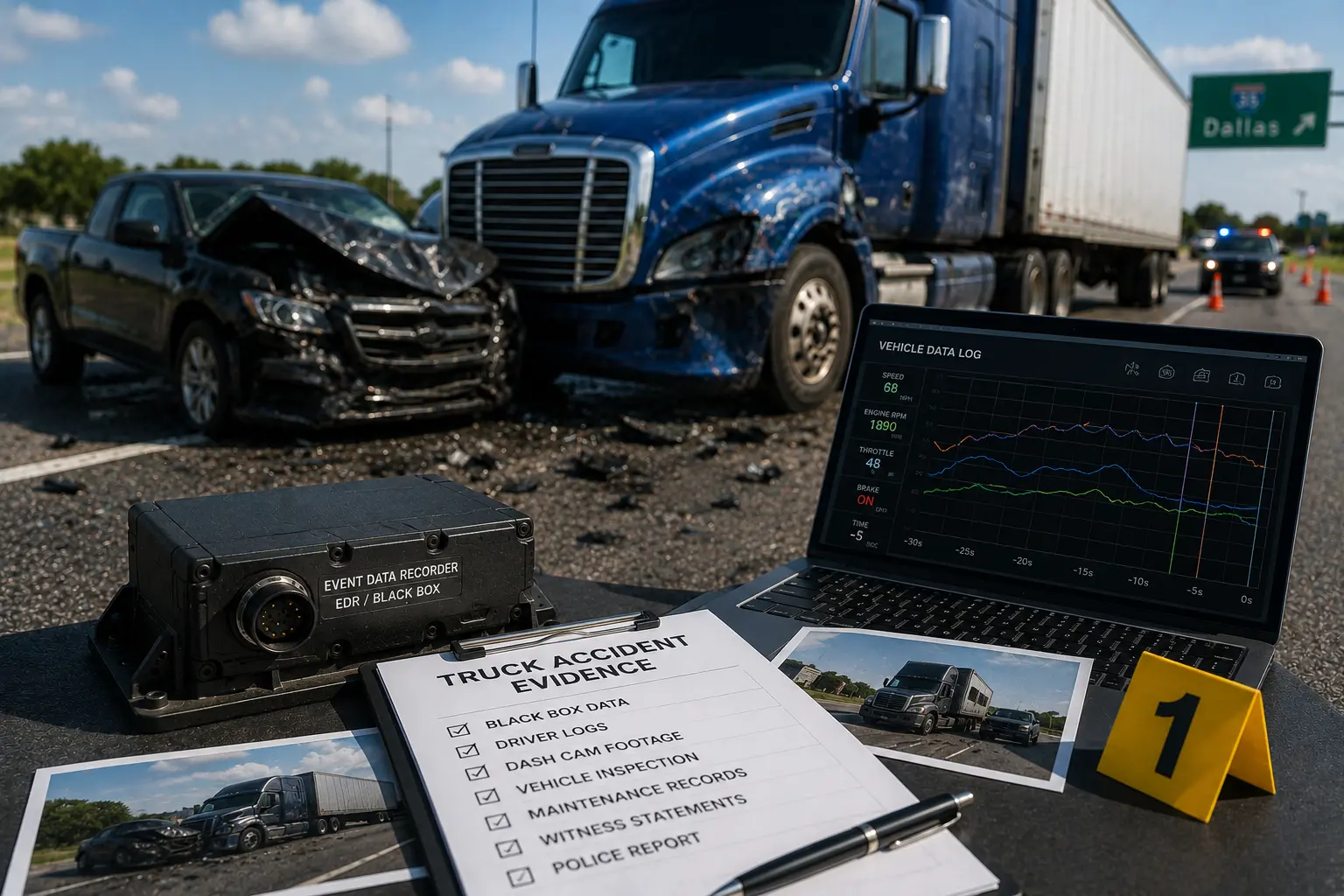
When Texas truck accident evidence black box data exists, it is frequently the difference between a clear win and a he-said-she-said dispute. The problem is that the best evidence is controlled by the trucking company and can vanish in days, sometimes within the first week of normal operation, which is why what you do, and what your lawyer does, in the first hours and days after the crash can decide the entire case long before it ever reaches a courtroom or a settlement table.
This guide explains what the data shows, how fast it disappears, and how a lawyer locks it down. It also covers what you can do yourself at the scene to make sure the right preservation demand reaches the right company in time. For how these cases are built and valued, see our Houston 18-wheeler accident page.
What the Black Box and ELD Logs Reveal
Every modern truck is a rolling data recorder. The engine control module, often called the black box or the event data recorder, captures exactly what the truck was doing in the moments before impact, and the electronic logging device separately tracks the driver’s hours.
The black box can log speed, brake application, throttle position, engine RPM, cruise-control status, and sudden changes in motion. That data can show the truck was speeding, never braked, or accelerated into the crash, often contradicting the driver’s account. Because the data is recorded automatically and tied to the truck’s systems, it carries weight that a witness or a driver’s recollection cannot match. Downloading it correctly takes the right tools and a qualified specialist, and doing it before the truck returns to service is essential, which is one more reason to move quickly. Juries trust numbers, and a black-box readout that contradicts the driver is powerful evidence. It also tends to settle disputes that would otherwise come down to one person’s word against another’s, which is exactly the kind of stalemate insurers exploit. With the data in hand, there is far less room for the carrier to spin the story. The numbers either back the driver or they do not, and when they do not, the case becomes much harder for the defense to fight on liability. That shift in the balance of the case is exactly what a prompt preservation effort buys you.
The ELD records duty status, engine hours, and movement, which proves whether the driver violated the federal hours-of-service rules. Those rules cap driving at 11 hours after 10 hours off duty, bar driving past the 14th hour on duty, and require a 30-minute break after 8 hours, and the device records compliance in a way a paper log never could. The Federal Motor Carrier Safety Administration has mandated ELDs for most commercial drivers since December 2017, replacing paper logs that were easy to fake. Because the ELD ties directly to the engine, it is far harder to manipulate than the old paper logbooks, which is exactly why it is such valuable evidence when a driver claims they were rested and within hours. The data can also reveal hard braking, sudden swerves, throttle input, and speed in the final seconds before impact, painting a precise second-by-second picture that a driver’s memory, or a carefully worded statement prepared after the fact, simply cannot contradict.
Need the truck’s data preserved? Call (727) 306-3324 or request a free case evaluation.
Dashcam, Driver Qualification Files, and Maintenance Records
The black box is only part of the picture. Many trucks now carry dashcams, some facing the road and some facing the driver, and that footage can settle a fault dispute in seconds.
The driver qualification file tells the story behind the driver: their license, training, prior violations, medical certification, and road-test records. It is where negligent-hiring and negligent-retention claims are proven or disproven. A driver with prior crashes, failed tests, or gaps in qualification is a record the carrier would rather you never see, and it is often the difference between a claim against the driver and a much larger claim against the company.
Maintenance and inspection records show whether the carrier kept the truck roadworthy. A history of ignored brake or tire problems can turn a single crash into evidence of a pattern, which strengthens the case against the company. These records are also the kind of evidence a carrier is least eager to hand over, which is exactly why preserving and demanding them early matters so much. Read together, these records often reveal whether a crash was a one-time failure or the predictable result of a company that put schedule ahead of safety. A formal demand, backed by the duty to preserve, is often the only thing that gets these internal records produced before they can quietly disappear. Together, the dashcam, the driver file, and the maintenance records let us show not only what happened in the crash but why it was likely to happen, which is what moves the case beyond the individual driver and squarely onto the company that employed and dispatched him. Telematics and GPS data add yet another layer of proof, showing the precise route, the stops, the speed, and the timing of the entire trip. Read alongside the logs, they can expose a delivery schedule that no rested driver could ever have kept legally, which points straight at how the carrier actually ran its operation and pushed its drivers.
Federal Retention Windows and How Evidence Disappears
Here is the urgent part. ELD records can be overwritten within weeks of normal operation, and under federal rules carriers are only required to retain ELD data for a minimum of six months. After that, it can lawfully be gone.
The black box is no safer. If the truck is repaired, returned to service, or sold, the data can be overwritten or lost. Dashcam footage loops and records over itself, sometimes within days. Nothing about this evidence is designed to wait for a lawsuit. Some carriers preserve everything responsibly. Others let damaging data cycle out through ordinary operation and then point to their routine retention practices. Either way, the result for an unrepresented victim is the same: the best proof can be gone before anyone asks for it. This is not a fair fight by default. The company controls the evidence, knows the retention windows, and has counsel involved within hours. Leveling that imbalance starts with getting your own demand on file before the routine destruction clock runs out.
Carriers understand all of this, and not every one of them rushes to preserve evidence that might hurt them. Without a prompt, formal demand to preserve it, the most important proof in your case can quietly disappear through ordinary business practice.
Worried the evidence is already disappearing? Call (727) 306-3324 or request a free case evaluation.
The Spoliation Letter and Why It Must Go Out Fast
A spoliation letter is a formal legal notice that tells the trucking company to preserve specific evidence, the black box, the ELD data, the dashcam footage, the driver file, and the maintenance records, because litigation is anticipated.
Once that letter is sent, the company has a legal duty to keep the evidence. If it destroys the material anyway, a Texas court can impose penalties, including instructing the jury that it may assume the lost evidence would have been harmful to the carrier. That consequence gives the letter real teeth.
The catch is timing. The letter only protects evidence that still exists when it arrives, so it has to go out in days, not weeks. This is one of the strongest reasons to call a lawyer immediately after a serious truck crash, before the data cycles out. The letter also signals to the carrier that the case will be handled seriously, which changes the tone from the first day. A company that knows its data is locked down is far less likely to gamble on a lowball offer. When a carrier ignores a proper preservation demand and the data vanishes anyway, that misconduct can become its own powerful evidence at trial, sometimes more damaging to the defense than the lost records would have been. Insurers know this, which is part of why a well-timed letter carries so much weight.
How Attorneys Use This Data to Prove Fault
Once preserved, this evidence does heavy lifting. It can establish fault, defeat a comparative-fault argument, and tie the carrier directly to the crash, all from internal records the trucking company would much rather you never get to see. That is precisely why the early preservation work is far more than routine paperwork. It is the foundation that everything else in the case is built upon. We pair the black-box data with the police report, scene photos, and witness accounts to reconstruct exactly what happened, often with the help of accident-reconstruction experts. A reconstruction built on hard, recorded data rather than guesswork is very difficult for the defense to attack. When the numbers, the physical evidence, and the witnesses all tell the same story, the carrier’s incentive to settle for a fair amount goes up sharply.
The data also defeats the carrier’s favorite move: shifting blame onto you. Texas comparative fault means every percentage point of fault the insurer pins on you comes off your recovery, so hard data showing the truck was speeding or the driver was over hours protects your share.
And a documented federal-rule violation, proven by the ELD, turns a disputed case into a clear one. Our guide to who is liable in a Texas truck accident explains how that evidence ties each defendant to the crash.
The same data feeds directly into value, because a clear fault picture supported by hard numbers is what justifies the larger damages these cases carry. Our Texas 18-wheeler settlement guide shows how proof translates into the size of a recovery.
What Victims Should Preserve Themselves
You cannot reach the truck’s black box on your own, but what you do at and after the scene still matters a great deal:
- Photograph the truck, its plates, the company name, and the USDOT number
- Photograph the scene, the vehicles, skid marks, and your injuries
- Get names and numbers of every witness
- Keep the police report number and the responding agency
- Save your own medical records and a daily note on your recovery
That information lets a lawyer aim the spoliation letter at the right company before it has time to clean house. The faster you act, the more of the truck’s own evidence can be saved. A short list of details from the scene, the company name, the USDOT number, the location, and the time, is often all a lawyer needs to send the preservation demand to the right place within a day. If you are too injured to gather any of that, do not worry. We can identify the carrier from the police report and public records, then move to preserve the evidence on your behalf. The most important thing is to get a lawyer involved quickly, before the clock runs. Family members can also pass along whatever they noticed or photographed at the scene. Every detail helps, but none of it is a substitute for moving fast, because the value of all this evidence depends on it still existing when the demand arrives. In a truck case, the first few days frequently matter more than the months that follow, because they decide whether the proof that wins the case survives at all. That single fact, more than anything else, is why we urge truck-crash victims to call before they do anything else, even before talking to the trucking company’s insurer. Our guide to what to do after a crash covers the scene steps in detail.
Just been in a truck crash? Call (727) 306-3324 or request a free case evaluation.
How United Law Group Can Help
We send the spoliation letter the day you call, move to preserve the black box and ELD data, and bring in reconstruction experts to turn that data into proof of fault. Speed is everything with truck evidence, and we treat it that way. Owner Jack Vasilaros reviews these cases personally.
We work on contingency, so there is no upfront cost and no fee unless we win. We advance the costs of building the case, and the consultation is free. Jack’s got your back from the first call to the final check.
What is a truck’s black box?
It is the engine control module or event data recorder, which logs speed, braking, throttle, engine RPM, and sudden changes in motion before a crash. That data can show what the truck was really doing at impact.
How long is truck accident evidence kept?
ELD records can be overwritten within weeks, and carriers must retain them for only six months. Dashcam footage can loop within days, and the black box can be erased if the truck is repaired or sold.
What is a spoliation letter?
A formal legal notice telling the trucking company to preserve specific evidence because litigation is anticipated. If the company destroys it afterward, a court can penalize the carrier, including telling the jury to assume the evidence was harmful to it.
Why do I need to act fast after a truck crash?
Because the most important evidence can disappear in days through normal business practice. A prompt spoliation letter only protects evidence that still exists when it arrives.
Can the black box data help my case?
Often dramatically. It can prove the truck was speeding, failed to brake, or that the driver violated federal hours rules, which establishes fault and protects your recovery under Texas comparative fault.
What evidence can I preserve myself?
Photos of the truck, its plates, the company name, and USDOT number, plus the scene, witnesses, the police report number, and your medical records. That lets a lawyer target the preservation demand correctly.
What does a truck accident lawyer cost?
Nothing upfront. We work on contingency, advance the case costs, and collect a fee only if we win. The consultation is free.